A process-selection guide for buyers comparing laser cutting, punching, and combined cutting. Learn how a TRUMPF TruMatic 6000 picks the right process per feature, and what to check in a cutting quote—file formats, edge quality, and material certs.
When a part needs both clean outer contours and a dense pattern of holes, the choice among laser cutting, punching, and a combined machine decides your unit cost, lead time, and edge quality. This guide explains how a combined laser/punch machine routes each feature to the right process, and what to verify in a sheet metal cutting service quote.
- Laser cutting gives clean, burr-free edges on contours, curves, and heat-sensitive features.
- Punching is faster and more economical for standard holes, slots, and forming features at volume.
- A combined machine applies the right process per feature in one setup, reducing handling and re-clamping.
- Your quote should confirm file formats accepted, edge quality criteria, and whether material test reports (MTRs) are available.
In this guide
Laser, punch, or both: choosing by feature
The right process depends less on the material and more on the geometry of each feature. A single part often contains contours that favor laser and hole patterns that favor punching.
When laser cutting wins
- Complex or curved contours where a smooth edge is required
- Small radii, narrow webs, and features that would deform under punching
- Heat-sensitive or thin material where minimal mechanical stress matters
- One-off or low-volume parts where tooling setup is not justified
When punching wins
- Standard round holes, slots, and rectangular cutouts at high volume
- Forming features such as louvers, embosses, and countersinks
- Parts where a sheared edge is acceptable and cycle time drives cost
- Repeat production where tooling is already available
When combined wins
A combined machine avoids the trade-off. It punches standard holes and forms, then laser-cuts the outer contour and any feature that needs a clean edge—without moving the part between machines. For a bracket with twenty holes and a curved profile, that means one setup instead of two, and no re-clamping error between operations.
How a combined laser/punch machine works
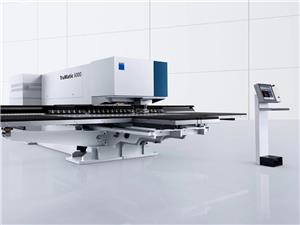
The TRUMPF TruMatic 6000 is a representative example: a combined laser and press that processes a sheet in a single pass. The control software assigns each feature to the appropriate process based on the part program.
Process routing per feature
- Holes and slots: routed to the punch head, which cycles faster than a laser for standard geometries.
- Forms and embosses: punched or formed with dedicated tooling while the sheet is still clamped.
- Outer contours and curves: routed to the laser for a clean, consistent edge.
- Fine or heat-sensitive features: laser-cut to avoid the mechanical stress of punching.
Because the part is positioned once, cumulative tolerance from multiple setups is avoided. The machine handles low-carbon steel, stainless steel, and aluminum, so a mixed-material job can be quoted as a single cutting operation.
Material differences: steel, stainless, aluminum
The same process logic applies across materials, but the edge result and the process split can shift. The table below summarizes typical considerations. Exact tolerances depend on material thickness and part geometry—confirm them with your supplier for the specific job.
| Material | Laser suitability | Punch suitability | Notes for quoting |
|---|---|---|---|
| Low-carbon steel | Clean contours, good edge | Fast for holes and forms | Combined routing often most economical |
| Stainless steel | Clean, oxidation-controlled edge | Careful tooling to avoid galling | Confirm edge finish and any post-processing |
| Aluminum | Good for contours and thin gauges | Effective for hole patterns | Specify alloy and temper; edge quality varies |
For aluminum, alloy and temper affect cut quality more than the machine itself. For stainless, the laser's shielding gas and focus settings determine whether the edge needs post-cleaning. These are process details a combined machine can handle, but they belong in the quote discussion, not in a generic tolerance claim.
What to check in a cutting quote
A cutting quote is only as good as the information behind it. Before comparing prices, verify these points.
File formats and data transfer
- Which CAD formats are accepted: STEP, IGES, DXF, DWG, or PDF?
- Is the native 3D model preferred over a 2D drawing for contour definition?
- Are bend lines, grain direction, and material callouts included?
Edge quality criteria
- Is a burr-free edge required, or is a sheared edge acceptable for some features?
- Are there specific dross or oxidation limits on stainless or aluminum?
- Will edges be deburred, and is that included in the quoted price?
Material documentation
- Are material test reports (MTRs) available for the supplied sheet?
- Does the material grade on the MTR match the drawing callout?
- Is traceability required for the batch, and is it recorded?
For suppliers serving automotive or industrial programs, a quality management system such as IATF 16949:2016 is a relevant indicator of process control. Ask whether the certificate applies to the site that will run your part.
If your parts also require forming, tapping, or assembly after cutting, see our Custom Sheet Metal Stamping Services and the related Custom Laser Cutting Services pages for capability details. For a broader view of tolerances, materials, and quality standards, read our Precision Sheet Metal Fabrication guide.
FAQ
Can one quote cover both laser and punching?
Yes. On a combined machine, the supplier can quote a single cutting operation that includes both processes. Ask for the process split to be shown if you want to understand where cost sits.
Which file format should I send?
STEP or IGES for 3D models, DXF or DWG for 2D profiles, and PDF for reference drawings. Include material, thickness, and quantity so the quote reflects the actual process routing.
How do I know the edge quality will meet my requirement?
State your edge requirement in the quote request—burr-free, deburred, or as-cut. For critical edges, request a sample or first-article inspection before full production. Samples passing does not automatically qualify the full batch, so agree on inspection criteria.
Are material certificates included?
MTRs are often available on request for the supplied material. Confirm availability and the specific grade before ordering, especially for stainless and aluminum where alloy and temper affect both cutting and final part performance.
If you are comparing processes for a specific part, send the drawing and material spec. The right answer usually depends on feature geometry and volume, not on a general preference for laser or punching.