
A practical comparison of laser cutting and CNC punching for sheet metal buyers, including when to use each process and when combined processing on the TRUMPF TruMatic 6000 delivers the best results.
Laser Cutting vs CNC Punching: Making the Right Process Choice
When your drawing calls for cutouts, holes, and formed features on a flat sheet metal panel, you face a fundamental process decision: laser cutting, CNC punching, or both. The wrong choice drives up per-part cost, extends lead time, and introduces quality variation that your incoming inspection team will catch - but only after the parts have shipped halfway across the world.
This guide breaks down the strengths and limitations of each process, explains when a combined approach wins, and gives you the decision criteria to discuss with your supplier before quoting. If you are sourcing electrical enclosures, machinery panels, brackets, or structural components, these distinctions directly affect your project timeline and budget.
Laser Cutting: Strengths and Limitations
Laser cutting uses a focused beam to melt, burn, or vaporize material along a programmed path. It excels at complex contours and handles a wide range of material thicknesses without tooling changes.
What Laser Cutting Does Best
- Complex outer contours and intricate cutouts: Any 2D shape that can be drawn in CAD can be cut - no custom tooling required.
- Material flexibility: Mild steel, stainless steel, and aluminum can all be processed on the same machine with parameter adjustments.
- No tooling investment: Unlike punching, laser cutting requires no physical tools - making it ideal for prototypes and low-volume runs.
- Clean edges on thinner materials: For sheet thicknesses up to approximately 4-5 mm, laser cutting produces smooth, burr-free edges with minimal heat-affected zone (HAZ).
- Tight nesting for material savings: Software-controlled cutting paths allow tight part nesting, reducing scrap and lowering material cost.
Where Laser Cutting Falls Short
- No forming capability: Laser cutting cannot create louvers, extruded holes, embosses, or countersinks. These require a punching or stamping operation.
- Slower for simple holes: If your part has many standard round or square holes, punching is faster and more cost-effective than cutting each one with a laser.
- Thicker material limitations: For plates above 6-8 mm, cut speed drops significantly and edge quality may degrade, increasing deburring time.
- Heat distortion on very thin sheet: On sheet below 1 mm, laser heat can cause warping - though a well-tuned machine minimizes this.
CNC Punching: Strengths and Limitations
CNC turret punching uses mechanical force to shear, form, and pierce sheet metal using standardized or custom tools mounted in a rotating turret. It is the workhorse of high-volume sheet metal fabrication.
What CNC Punching Does Best
- Formed features in a single hit: Louvers, extruded holes, ribs, embosses, countersinks, and V-cuts are produced in one stroke - no secondary operation needed.
- High speed for repetitive holes: A turret punch can hit dozens of standard holes per minute, making it far faster than laser for parts with many perforations.
- Consistent feature placement: Once the tool is loaded and the program is set, feature position repeats within tight tolerances across every part in the batch.
- Lower per-part cost at volume: For medium to high volumes, the speed and tooling efficiency of punching make it more economical than laser cutting.
Where CNC Punching Falls Short
- Tooling constraints: Each formed feature requires a specific tool. If your design calls for a non-standard shape, custom tooling adds cost and lead time.
- Complex contours are limited: Punching cannot produce the intricate outer shapes that laser cutting handles easily. Very complex profiles may require a nibbling approach, which leaves visible tool marks.
- Material thickness limits: Most turret punches are optimized for sheet up to 3-4 mm. Thicker materials may require different equipment.
- Setup time for tool changes: Switching tools between jobs adds setup time, which affects cost for small-batch or prototype work.
The Combined Approach: TRUMPF TruMatic 6000
Some parts need both complex contours and formed features - and this is where a combined laser-punching machine changes the economics. The TRUMPF TruMatic 6000 integrates laser cutting and CNC punching in a single workstation, processing a sheet from raw stock to finished blank without intermediate handling.
Why Combined Processing Wins
| Factor | Separate Laser + Punch | Combined (TruMatic 6000) |
|---|---|---|
| Handling between operations | Sheet must be unloaded, transported, and re-loaded - risk of scratches and position variation | Sheet stays on the same machine bed - zero handling between cut and form operations |
| Tolerance stack-up | Each re-clamping introduces positioning error | Single coordinate system - features remain aligned to the same datum |
| Lead time | Two machine bookings, two setup times, queue wait between them | One setup, one program, one machine cycle |
| Cost structure | Two machine-hour rates plus handling labor | One combined cycle - lower total machine cost per part |
| Prototyping flexibility | Tooling commitment needed before laser cutting can begin | Laser handles contours; punch handles forms - design changes only require a program update |
For buyers sourcing panels that combine intricate cutouts with formed features (e.g., an electrical enclosure with ventilation louvers, connector cutouts, and mounting embosses), combined processing on the TruMatic 6000 eliminates the quality risks and coordination costs of splitting the work across two machines.
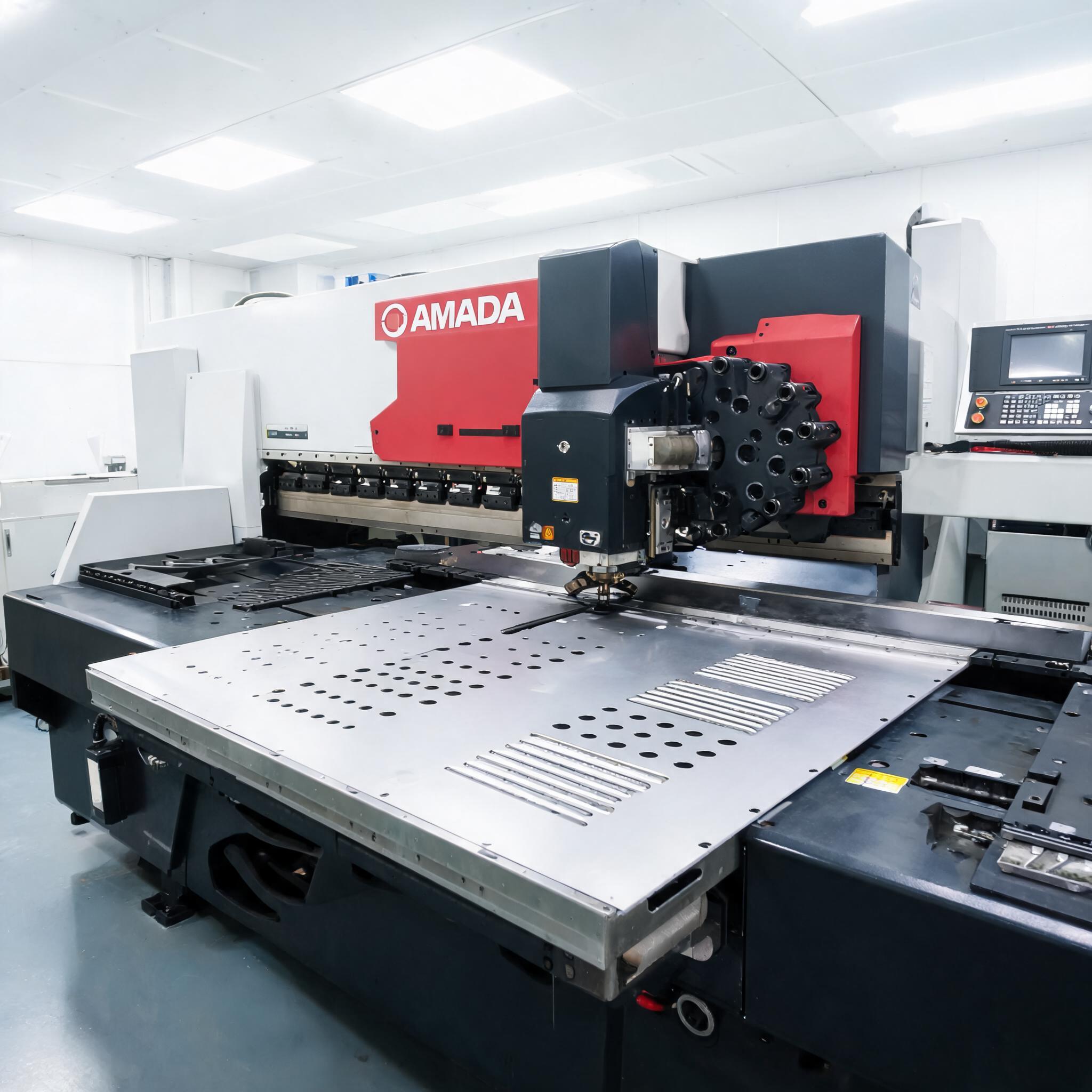
Amada Turret Punch: When Dedicated Punching Is the Right Call
Not every part needs laser cutting. For high-volume panels with standard holes and formed features but relatively simple outer contours, a dedicated Amada CNC turret punch press is often the most efficient and cost-effective choice. The Amada's large-capacity turret with multiple tool stations minimizes setup changeover, making it ideal for:
- Electrical enclosure panels with ventilation louvers, knockouts, and mounting features produced in a single setup
- High-volume bracket production where speed and repeatability matter more than contour complexity
- Parts with many standard holes where punching speed dramatically outperforms laser cutting
Decision Framework: Which Process for Your Part?
Use this checklist to guide your conversation with your supplier before quoting:
- Does your part have formed features? (louvers, extruded holes, ribs, embosses, countersinks) -> If yes, punching is required. If no, laser cutting alone may suffice.
- Does your part have complex outer contours? (curves, intricate shapes, many non-standard cutouts) -> If yes, laser cutting is required. If no, punching may be sufficient.
- Does your part have both? -> Combined processing on the TRUMPF TruMatic 6000 is the most efficient path.
- What is your volume? -> Prototype/low volume favors laser (no tooling). Medium/high volume favors punching (speed advantage). Combined processing works across all volumes.
- What material and thickness? -> Thin sheet (under 1 mm) may warp with laser; thick plate (over 6 mm) may be too slow for laser. Punching is optimized for 0.5-4 mm range.
- How tight are your tolerances? -> Combined processing on one machine bed eliminates re-clamping error. If critical features must align to the same datum, choose combined.
Quality Verification: What to Check Regardless of Process
Whether your parts are laser cut, punched, or processed on a combined machine, your incoming inspection should verify:
- Dimensional accuracy: Check cut/profile dimensions and feature positions against drawing tolerances. The supplier should provide a dimensional layout report.
- Edge quality: Laser-cut edges should be clean with minimal burr and HAZ. Punched edges should be clean shear cuts without excessive rollover or burr.
- Feature consistency across the batch: Measure feature positions on parts from the beginning, middle, and end of the production run to verify process stability.
- Material certificates: Verify material grade and heat number match the specification on your drawing.
For a comprehensive overview of how sheet metal parts move through fabrication after cutting and punching, see our sheet metal manufacturing process guide. To discuss specific capabilities, visit our laser cutting services and CNC punching and stamping services pages.
Not sure whether laser cutting, CNC punching, or combined processing is right for your parts?
Send your drawing for a process recommendation