
A complete guide to the sheet metal manufacturing process - cutting, forming, joining, finishing, and inspection - with DFM tips and supplier evaluation criteria.
Sheet Metal Manufacturing: A Complete Guide to the Fabrication Process
Sheet metal manufacturing transforms flat metal sheets into functional components through a sequence of cutting, forming, joining, and finishing operations. For machinery importers, distributors, and EPC buyers, understanding this process is essential for evaluating supplier capability, anticipating lead times, and identifying design choices that reduce cost without compromising structural integrity.
This guide walks through each stage of the sheet metal manufacturing process - from material selection to final inspection - with practical insights on how design decisions at each step affect quality, cost, and delivery.
What Is Sheet Metal Manufacturing?
Sheet metal manufacturing is a family of fabrication processes that work with metal stock typically ranging from 0.5 mm to 6 mm in thickness. Unlike machining, which removes material from a solid block, sheet metal forming reshapes flat stock into three-dimensional parts through cutting, bending, stamping, and welding. The result is lightweight, structurally efficient components - enclosures, brackets, chassis, panels, and assemblies - used across machinery, electronics, and industrial equipment.
Common materials include:
- Cold-rolled steel (SPCC): Cost-effective, good formability, suitable for painted or plated finishes
- Galvanized steel (SECC): Corrosion resistance for outdoor or humid environments
- Stainless steel (304/316): Chemical and corrosion resistance for food, medical, and marine applications
- Aluminum (5052/6061): Lightweight, good strength-to-weight ratio, excellent for enclosures requiring thermal dissipation
The 6 Stages of Sheet Metal Manufacturing
1. Design and Engineering Review
Every sheet metal project begins with a design review. Engineers evaluate the CAD model against manufacturing constraints - bend radius feasibility, hole-to-edge distances, flange lengths, and weld joint accessibility. This stage also confirms material selection, surface finish requirements, and tolerance specifications.
A thorough manufacturability review at this stage prevents costly rework later. For example, specifying a bend radius smaller than the material thickness risks cracking; placing holes too close to a bend line distorts them during forming. These issues are far less expensive to resolve in the design phase than on the production floor.
2. Cutting and Blanking
The first physical operation cuts the flat sheet to the blank shape that will be formed into the final part. Several cutting methods are available, each suited to different part geometries and volumes:
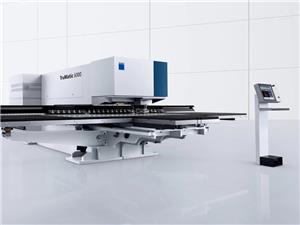
- Laser cutting: High-precision, non-contact cutting ideal for complex outlines and varying thicknesses. A fiber laser produces clean edges on steel, stainless, and aluminum with minimal heat-affected zone. Equipment like the TRUMPF TruMatic 6000 combines laser cutting with punching in a single machine, eliminating intermediate handling and improving positional accuracy.
- CNC punching (turret press): Efficient for high-volume parts with repetitive hole patterns, louvers, embosses, or extruded holes. Turret presses like the Amada can form these features in a single hit, reducing cycle time compared to laser-only processing.
- Waterjet cutting: Used for thick plates or heat-sensitive materials where laser cutting would cause distortion or metallurgical changes.
The choice between laser and punch depends on part complexity, volume, and feature mix. A combined laser-punch machine offers the flexibility of both methods in one setup.
3. Forming and Bending
Press brakes transform flat blanks into three-dimensional parts by bending the metal along defined lines. Key considerations in this stage include:
- Bend radius: Should be at least equal to the material thickness to prevent cracking. Standard tooling sets cover common radii; custom radii require dedicated tooling.
- Bend allowance and K-factor: The material stretches on the outside and compresses on the inside of a bend. Engineers calculate bend allowance to ensure the flat pattern dimensions produce the correct final geometry.
- Springback: All metals spring back slightly after bending. The amount depends on material type, thickness, and bend angle. Skilled operators compensate by over-bending by a calculated amount.
- Multi-bend sequencing: Parts with multiple bends must be sequenced to avoid interference between the workpiece and the tooling. Complex parts may require specialized fixtures or multi-axis press brakes.
4. Joining and Welding
After forming, individual components are joined into assemblies. Common joining methods in sheet metal manufacturing include:
- MIG welding (GMAW): High-deposition-rate welding suitable for thicker sheet and structural joints. Common for enclosure frames and support brackets.
- TIG welding (GTAW): Precise, low-heat-input welding ideal for thin-gauge sheet, stainless steel, and aluminum. Produces clean welds with minimal post-weld finishing.
- Spot welding: Resistance welding for lap joints in thin sheet. Fast and economical for enclosure panels and internal brackets.
- Riveting and hardware insertion: PEM inserts, rivet nuts, and standoffs are pressed into pre-punched holes to provide threaded fastening points in thin sheet metal.
Welding distortion is a key concern - heat input causes localized expansion and contraction that can warp flat surfaces and shift hole positions. Experienced fabricators control distortion through weld sequence planning, fixturing, and post-weld straightening.
5. Surface Finishing
Surface finishing protects the part from corrosion and provides the required appearance. Common processes include:
- Powder coating: Durable, cost-effective finish available in a wide range of colors and textures. Suitable for most steel and aluminum parts.
- Anodizing (aluminum): Creates a hard, corrosion-resistant oxide layer. Type II for decorative finishes, Type III (hardcoat) for wear resistance.
- Zinc plating / passivation: Corrosion protection for steel parts where paint is not required.
- Brushing / polishing: Decorative finishes for stainless steel panels and visible components.
Finishing requirements should be specified early, as they affect upstream decisions - for example, powder coating adds thickness that must be accounted for in press-fit or threaded assemblies.
6. Inspection and Quality Control
The final stage verifies that the finished part meets dimensional, visual, and functional requirements:
- Dimensional inspection: CMM measurement, height gauges, and gauging fixtures verify bend angles, hole positions, and overall dimensions against the drawing.
- First Article Inspection (FAI): A complete dimensional report on the first part of a production run, documenting every specified dimension and tolerance.
- Weld inspection: Visual inspection for weld quality, with penetration testing or radiography for critical structural joints.
- Surface finish verification: Coating thickness measurement, adhesion testing, and visual inspection for uniformity.
Suppliers operating under IATF 16949 or ISO 9001 quality systems maintain documented inspection procedures and provide traceable quality records with each shipment.
Design for Sheet Metal Manufacturability
Several design practices reduce cost and improve quality in sheet metal manufacturing:
- Consistent bend radius: Use the same radius for all bends to reduce tool changes and setup time.
- Avoid deep pockets in thin sheet: Deep pockets require multiple tool passes and risk material distortion.
- Design near-rectangular blanks: Nested rectangular shapes minimize material waste compared to irregular outlines.
- Standardize hole sizes: Using common hole diameters reduces tool changes on turret punches.
- Provide access for welding: Design weld joints with sufficient clearance for torch or electrode access.
Choosing a Sheet Metal Manufacturing Partner
When evaluating sheet metal suppliers, consider the following capability indicators:
- Equipment range: Does the supplier offer laser cutting, punching, bending, and welding in-house? In-house capability reduces transit between subcontractors and improves quality accountability.
- Quality system certification: IATF 16949 or ISO 9001 certification demonstrates a documented, audited quality management process.
- Engineering support: Does the supplier review designs for manufacturability and provide feedback before production? Proactive engineering review prevents costly rework.
- Inspection capability: In-house CMM and FAI capability ensures quality verification without relying on third-party labs.
At Zhuhai ChunTian Machine Technology, our sheet metal manufacturing process is built around industry-leading equipment, including the TRUMPF TruMatic 6000 combined laser-punching machine and Amada turret press. Since 2009, we have served machinery importers, distributors, and EPC buyers worldwide with a full-range fabrication capability - from laser cutting and CNC punching through bending, welding, and final inspection. Our IATF 16949-certified quality system ensures every part ships with documented inspection records and material traceability.
Conclusion
Sheet metal manufacturing is a multi-stage process where each operation - cutting, forming, joining, finishing, and inspection - depends on decisions made in the preceding stages. By understanding the process and designing for manufacturability, buyers can reduce cost, improve quality, and accelerate delivery. The most successful projects begin with a collaborative design review between buyer and supplier, where potential issues are identified and resolved before the first sheet is cut.