
A practical guide for automotive and machinery buyers on what to verify when evaluating an IATF 16949-certified sheet metal supplier - from PPAP deliverables to equipment capabilities and audit questions.
Why IATF 16949 Matters for Sheet Metal Sourcing
When you source sheet metal components for automotive or machinery applications, your supplier's quality management system is not a checkbox - it is the framework that determines whether every shipment meets the same dimensional and material specifications as the approved first article. IATF 16949:2016 is the automotive industry's most demanding quality standard, built on ISO 9001 but adding customer-specific requirements, risk-based thinking, and defect prevention throughout the entire production cycle.
But holding a certificate and operating to the standard are two different things. This guide covers what automotive buyers and machinery importers should verify when evaluating an IATF 16949-certified sheet metal supplier - and how those requirements translate into tangible deliverables you can check during supplier audits and incoming inspection.
What IATF 16949 Requires That ISO 9001 Does Not
IATF 16949 adds several layers of discipline that directly affect part quality and delivery consistency. Understanding these requirements helps you ask the right questions during supplier evaluation:
- Advanced Product Quality Planning (APQP): Suppliers must follow a structured APQP process - from feasibility review to production trial run - before full-scale manufacturing begins. This means your supplier should deliver a Production Part Approval Process (PPAP) package, not just a quote.
- Process Failure Mode and Effects Analysis (PFMEA): The supplier must identify potential process failures and implement controls for each. Ask to see the PFMEA for your specific part - it shows whether they have thought through what can go wrong during laser cutting, stamping, bending, and welding.
- Statistical Process Control (SPC): Critical characteristics identified in the control plan must be monitored using SPC methods. You should receive SPC data with your shipments, not just a pass/fail report.
- Internal audits and management review: The supplier must conduct regular process audits, layer audits, and management reviews. These records demonstrate ongoing compliance, not just a one-time certification audit.
- Supplier development: IATF 16949 requires the certified supplier to monitor and develop their own sub-suppliers - meaning your material traceability chain extends beyond the fabricator to the raw material source.
Equipment That Determines Whether IATF 16949 Is Meaningful
A supplier can hold IATF 16949 certification and still produce inconsistent parts if their equipment cannot hold the tolerances your drawings specify. The certification ensures processes are controlled - but the equipment determines the capability ceiling. When evaluating a sheet metal supplier, verify that their core equipment matches your tolerance and volume requirements:
| Equipment | Role in IATF 16949 Compliance | What to Verify |
|---|---|---|
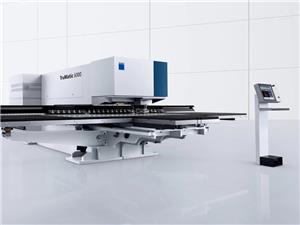
| TRUMPF TruMatic 6000 (laser + punch combo) | Combines laser cutting and CNC punching in one setup, reducing handling-induced variation - a key process stability factor in control plans. | Ask whether your parts will be processed on this machine or a separate punch press. Combined setups reduce tolerance stack-up. |
| Amada CNC turret punch press | High-precision forming (louvers, extruded holes, ribs) with repeatable positioning accuracy across batches. | Verify tool availability for your required formed features before quoting. Missing tools mean secondary operations and added variation. |
| Laser welding robot | Low heat-input welding that minimizes distortion on thin-gauge sheet - critical for maintaining dimensional stability after joining. | Ask about weld distortion control methods and post-weld dimensional verification. |
| 5-axis CNC machining center | Finishing operations on welded or stamped assemblies - achieving IT6–IT7 tolerances on machined features. | Confirm the supplier can machine critical datums in a single setup to avoid tolerance accumulation. |
The PPAP Package: What You Should Receive
For automotive buyers, the PPAP (Production Part Approval Process) submission is the most tangible evidence that your IATF 16949 supplier is operating to the standard. At a minimum, your supplier should provide:
- Dimensional layout report: Full dimensional inspection of the production part against drawing requirements, including all critical and significant characteristics.
- Material test certificates: Mill certificates confirming material grade, heat number, and compliance with specified standards (e.g., ASTM, EN, JIS).
- Performance test results: Any functional, corrosion, or weld tests specified in the drawing or control plan.
- Initial process studies: SPC data showing process capability (Ppk/Cpk) for critical characteristics - typically from a minimum 25-piece production run.
- Control plan and PFMEA: The living documents that govern how the part is produced and inspected on the shop floor.
- First Article Inspection (FAI) report: A documented inspection of the first part produced, verified against the CAD model.
If your supplier cannot deliver these documents, the IATF 16949 certificate is not translating into operational discipline - and your incoming inspection will bear the cost.
Tolerance Capabilities to Confirm Before Sourcing
IATF 16949 requires suppliers to demonstrate process capability for critical characteristics. But capability is meaningless if the equipment cannot physically achieve the tolerance. Here are the baseline capabilities you should confirm:
| Process | Achievable Tolerance | Inspection Method |
|---|---|---|
| CNC turning | IT6–IT7 as standard | SPC data, FAI report, CMM verification |
| 5-axis CNC machining | 0.005 mm positioning accuracy for critical datums | CMM verification against CAD model |
| Laser cutting (TRUMPF TruMatic 6000) | Consistent cut quality across batch with minimal burr and HAZ | Dimensional check, edge quality inspection |
| CNC punching (Amada) | Repeatable feature placement across production runs | Dimensional layout, feature position verification |
| Laser welding | Low distortion, consistent penetration on thin-gauge joints | Post-weld dimensional inspection, weld bead inspection |
Supplier Audit Checklist: 8 Questions to Ask
Whether you are conducting an on-site audit or a remote supplier evaluation, these questions help you verify that IATF 16949 is operational - not just a wall certificate:
- Show me your latest IATF 16949 certificate and scope. Verify the certificate is current and covers the manufacturing processes you need (sheet metal fabrication, CNC machining, welding).
- Walk me through your APQP process for a recent automotive part. Listen for structured phases: feasibility, design review, process design, validation, and launch.
- Can I see a sample PPAP package for a similar part? If they cannot produce one, the certification is not generating customer-facing deliverables.
- What SPC data do you include with shipments? You should hear specific characteristics, control charts, and capability indices - not "we can provide if requested."
- How do you handle nonconforming product? Look for documented corrective action (8D) and containment procedures, not verbal assurances.
- What equipment will process my parts? Confirm the TRUMPF TruMatic 6000, Amada punch press, or 5-axis machining center will be used - not a general-purpose machine.
- What is your traceability system? Material certificates, heat numbers, and lot tracking should be tied to each shipment.
- What other certifications do you hold? ISO 9001, ISO 14001:2015, ISO 13485:2016, and ASME authorization provide additional evidence of process discipline across industries.
Common Gaps That Undermine IATF 16949 Suppliers
Even certified suppliers can fall short in practice. Watch for these warning signs during evaluation:
- Outdated equipment: A supplier running 15-year-old punch presses without modern CNC control may hold the certificate but cannot maintain consistent feature placement across batches.
- Missing process documentation: If the control plan does not reference specific machine programs, tool IDs, and inspection frequencies, the plan is decorative.
- No capability studies on file: A supplier that cannot show Cpk data for critical characteristics is not measuring process capability - they are inspecting parts after the fact.
- Outsourced processes without control: If welding or heat treatment is outsourced, the supplier must still control and document these processes under IATF 16949. Ask for evidence.
How ChunTian Supports Automotive and Machinery Buyers
Zhuhai ChunTian Machine Technology Co., Ltd. has specialized in precision sheet metal fabrication and CNC machining since 2009. Our facility holds IATF 16949:2016 certification alongside ISO 9001, ISO 14001:2015, ISO 13485:2016, and ASME authorization - providing the multi-standard quality framework that automotive and industrial buyers require.
Our core equipment includes the TRUMPF TruMatic 6000 combined laser-punching machine, Amada CNC turret punch press, laser welding robots, and 5-axis CNC machining centers capable of 0.005 mm positioning accuracy. Every project starts with a drawing review and manufacturability assessment, and every shipment includes dimensional inspection data, material certificates, and QC documentation.
For a deeper look at our fabrication workflow, see our complete sheet metal manufacturing process guide. To explore specific capabilities, visit our laser cutting services and CNC punching and stamping services pages.
Need an IATF 16949-certified sheet metal supplier for your next automotive or machinery project?
Request a quote with PPAP documentation