
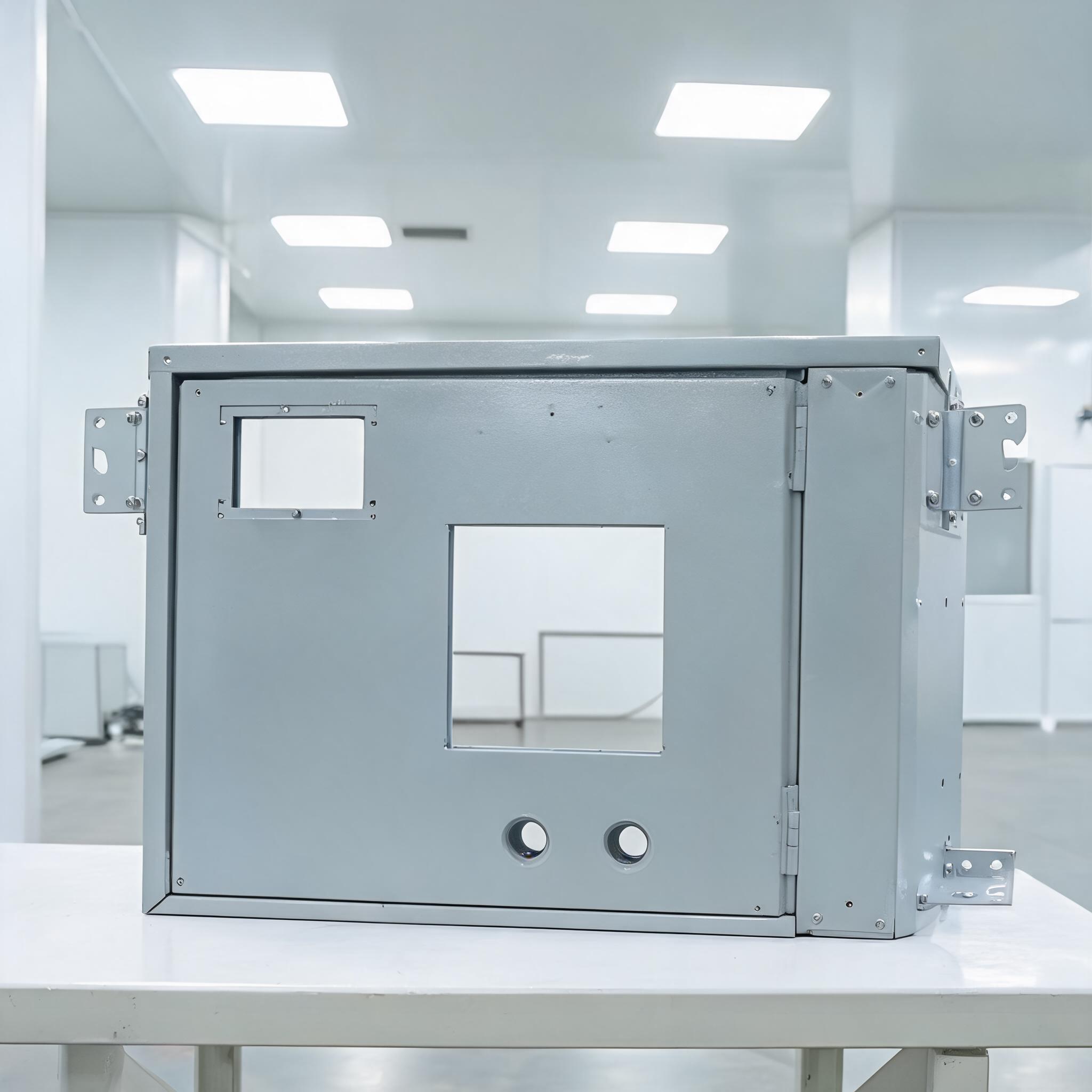
When metal fabrication and powder coating happen in one facility, forming decisions and coating decisions are made by the same team. This article explains what that integration changes for buyers — no inter-plant transport damage, a single QC trail from cut to cured part, and masking decided where the part is formed. It also covers when separate coaters still make sense.
Fabrication & Finishing
When the company that forms your part also coats it, there is no handoff between facilities. That single change removes several common failure points from an order.
Key takeaways
- Parts that are formed and coated in the same facility never travel between plants, so transport scratches and re-handling drop out of the process.
- Masking, racking, and coating thickness are decided at the same table as bend radii and weld locations.
- One QC trail covers the part from cut to cured, instead of two records that do not map onto each other.
- Separate coaters still make sense for some jobs. The article explains which conditions.
In this article
Where the surprises normally come from
A fabricated enclosure or bracket leaves the fabricator as bare steel, aluminium, or stainless. Before it reaches the end user it has to be finished — usually with powder coating, sometimes with a custom colour matched to a RAL reference or a customer sample. When fabrication and finishing happen at separate companies, that bare part physically moves between them.
The motion itself is the risk. Parts are stacked, banded, and trucked as work-in-progress rather than finished goods. Edges are bare and unforgiving. Even with careful packing, some fraction of a batch picks up handling marks, nicks, or distortion that did not exist when the part was inspected on the fabricator's floor. By the time the coater sees it, the question is no longer only "does this part fit" but "is this mark a forming defect or a transit defect?"
That question has a cost. It has to be answered before anyone can decide who fixes what, and it often arrives in the middle of a production schedule. Integrated fabrication and powder coating avoids the question entirely, because the part is inspected and finished in the same place that formed it.
Two further handoffs tend to create friction when the businesses are separate. First, the buyer has to relay design information — bend radii, weld locations, hardware placement — to a coater who never saw the drawing. Second, return freight and re-work on a rejected batch are paid on a finished part that cannot be repaired as easily as it can be re-coated, though re-coating bare or previously coated steel is a service that a coater handles routinely.
Coating decisions made where forming decisions are made
Masking is the clearest example. Threaded holes, mating surfaces, and electrical contact points must stay bare, and the drawing normally specifies exactly which ones. When the fabricator and the coater are the same team, the person who set the hole placement also sees the masking requirement, so it is not passed along as a note that can be misread. Masking is applied per drawing, and the same team can tell you whether a given mask will survive the cure cycle on the specific part geometry.
Forming choices also feed back into finish quality. A radius that is a little tight, a weld spatter field that was not dressed, or a bracket that will trap powder in a blind corner all show up in the finish. When the coater is a separate business, those issues are usually found after the part has crossed a loading dock. When the coater is in-house, the finishing team can flag the issue while the part is still on the fabricator's bench. Racking and hanging points are agreed during the same conversation.
The colour decision is normally straightforward. A job is coated to a RAL number or matched to a customer-supplied sample. What integration changes is not the colour itself but who owns the sign-off. One team confirms the colour against the sample or RAL reference, records it, and coats the whole batch — no split responsibility for "the finish is close but not exact."
A single QC trail from cut to cured part
An integrated shop can run one inspection record across the whole process. Concretely, that record can cover:
- Incoming material identification.
- Forming and welding checks against the drawing revision.
- Pre-treatment and masking confirmation before coating.
- Powder application and thermal cure parameters.
- A finished-part photo pack showing the coated part and, where relevant, the masked areas.
The point of a single trail is traceability, not paperwork for its own sake. If a batch is queried weeks later, there is one reference to open rather than two systems that use different part and batch numbering. For buyers in industries where documentation actually gets audited, that matters more than the day-to-day quality of any single coat.
An integrated supplier can also hold quality management certification across both functions. If a supplier operates to a recognised standard such as IATF 16949:2016, the audit and corrective-action record covers forming and coating together. That is a detail worth confirming in writing before it is written into a purchase order, because certification scope is not automatically the same at every site.
How the powder coat itself is applied
Powder coating is an electrostatic process followed by a thermal cure. Charged powder is sprayed onto a grounded part, so it clings to the surface, including the interior of a formed enclosure where a liquid finish would sag or run. The coated part then goes through a cure oven, where the powder flows and cross-links into a continuous film. Because the process is dry and the film forms before cure, thickness tends to be more even than a sprayed wet coating, especially on complex geometry.
A shop that does its own fabrication has an advantage at the oven stage. It knows the part geometry — the wall thickness, the bends, the heat sinks — because it formed the part. That knowledge feeds directly into racking and cure settings. A coater receiving a box of unfamiliar parts is working from the buyer's description and a visual inspection rather than from the drawing that defined the part.
When separate coaters still make sense
Integration is not automatic for every order. A separate coater can be the better answer in a few situations:
- A specialised finish outside the fabricator's process. If the requirement is a high-performance fluoropolymer, a specific Kynar system, or a coating with a certification the fabricator does not carry, the right shop may be a specialist. Let the finish dictate the supplier.
- Very high volume, tolerance work. In some cases, a dedicated coater has capacity or line configuration that a general fabricator cannot match, and the volume justifies the extra logistics.
- Existing customer qualification. Where the buyer's own approval process has already qualified a specific coater, changing to an integrated shop may not be worth re-qualifying for a small batch.
- Repair and re-coat only. If a finished part simply needs to be stripped and re-coated, an independent coater may be the fastest route.
For buyers placing a mixed order — some parts that need forming and finishing, some that only need coating — an integrated supplier can often handle both. Confirm the split before quoting, because the coating-only portion uses different handling and documentation.
Questions to ask
- Does the same facility form and coat the part, or is finishing subcontracted?
- Can you provide the QC record for the whole order — forming through curing — under one batch reference?
- How is masking specified and verified? Can you show it on the drawing before coating?
- Which colour standard is used — RAL, Pantone, or a physical sample?
- Can you issue a photo pack of the finished, masked, and cured part before shipment?
If the answer to the first question is "no," the rest of the questions still apply, but they are now three separate conversations instead of one. That is the practical difference integration makes.
FAQ
Does single-facility coating really reduce damage, or is that just a claim?
The mechanism is simple: parts that are formed and coated under one roof do not need to be packed and transported as bare, work-in-progress goods between two sites. Removing that step removes the handling that causes most transit nicks. The reduction is a process effect, not a marketing promise — but exact figures depend on the parts and the batch, so ask a supplier for their handling and inspection procedure.
Can I supply my own sample colour for matching?
Yes. Coating can be matched to a customer-supplied physical sample as well as to a RAL number or another colour reference. The shop records the reference against the order so repeat orders use the same target. Confirm acceptance criteria and light source for the match before production.
How do I know masking was done correctly?
Masking is applied per drawing, so the drawing should state which features must remain bare. At the end of the run, ask for inspection or photo evidence of the masked areas. If the part has critical threaded or contact surfaces, include those in the agreed inspection points rather than relying on a visual check alone.
What certification should an integrated fabricator and coater hold?
It depends on your industry. Automotive-adjacent work often requires a quality management system such as IATF 16949:2016, and certification scope should be confirmed against the specific site and process. Other sectors may require a different standard. Ask for the certificate and confirm it covers both fabrication and finishing before you write it into a purchase order.
Putting it together
The argument for keeping metal fabrication and powder coating under one roof is not that either process becomes better in isolation. It is that the interface between them disappears. Fewer handoffs mean fewer places for a part to be scratched, a masking note to be misread, or a quality record to be split. For orders where finish quality and traceability carry real weight, that is usually worth more than a small price difference.
If you are scoping a project that needs forming and finishing, the place to start is the drawing and the colour reference. A supplier who performs both can look at the same document for bend radii, masking, and cure requirements and quote from a single file.