
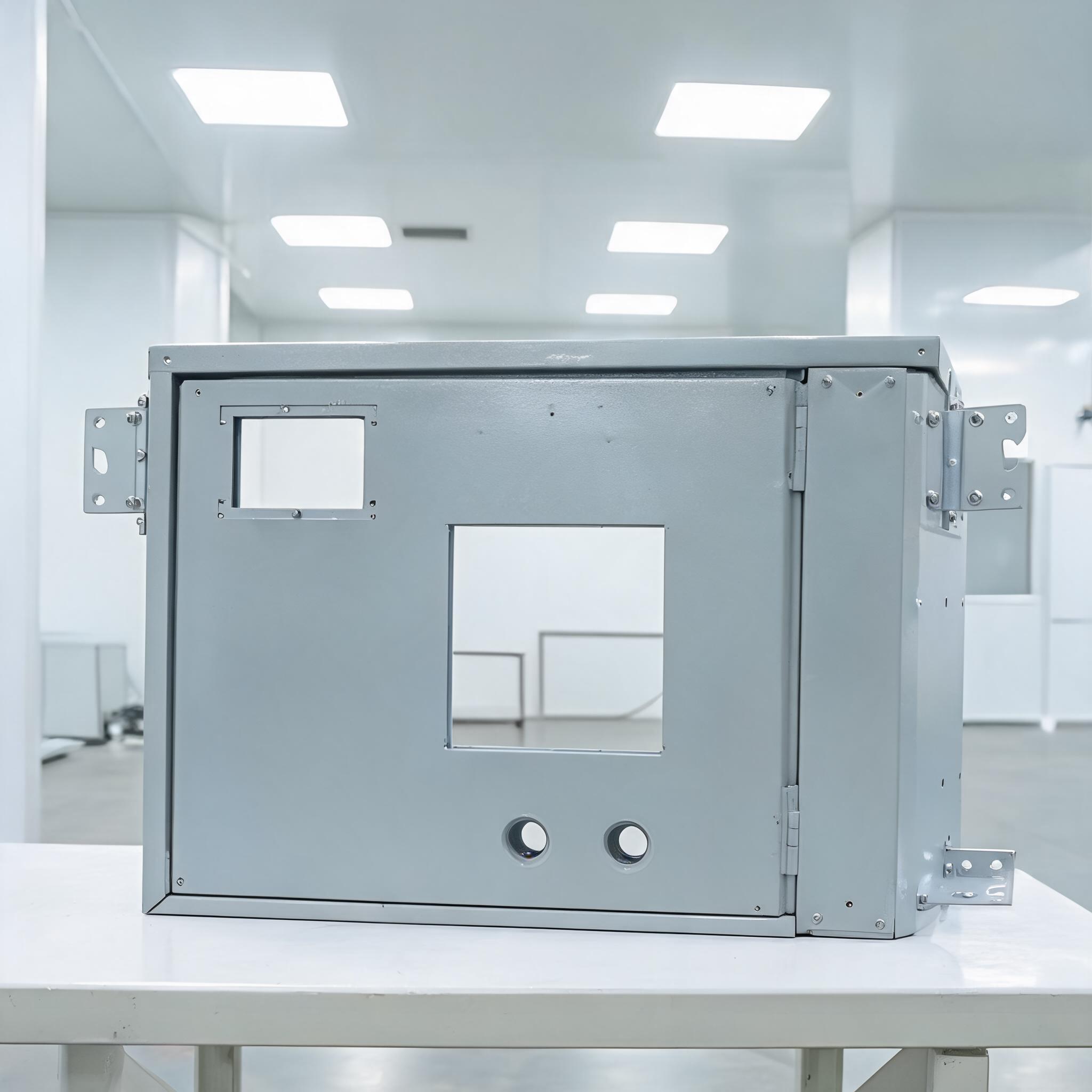
A practical RFQ checklist for custom metal enclosures: how environment, access, mounting, cable entries, grounding, finish and RAL color each translate into a fabrication decision your supplier needs before quoting.
RFQ Specification Guide
Most delays on custom metal enclosures do not come from welding or bending. They come from a drawing that leaves the environment, the access method, or the finish open to interpretation. The fabricator then guesses, the quote comes back with assumptions, and the first article does not match what the buyer had in mind.
This checklist walks through the seven specification points that drive real fabrication decisions: environment, access, mounting, cable entries, grounding, finish, and color. Each one is tied to what the shop actually has to do differently on the floor, so the RFQ arrives with enough information to quote and build without a second round of questions.
Key takeaways
- Indoor, outdoor, dust, and splash conditions set the material, the sealing method, and often the coating system.
- Door and panel access is a hinge, gasket, and stiffening decision, not a cosmetic one.
- Mounting points, cable entries, and grounding get defined by dimension, not by description.
- Finish and RAL color must be stated as a standard reference or a physical sample, with masking called out on the drawing.
Start with the operating environment
Environment is the first question on a custom metal enclosure RFQ because it narrows everything downstream. An indoor control panel in a climate-controlled room and an outdoor equipment housing exposed to rain are not the same product, even if the drawing outline looks similar.
Ask the buyer to state the installation location plainly: indoor conditioned, indoor washdown, outdoor sheltered, or outdoor exposed. Then state the specific hazards present — dust, splash, hose-directed water, or none. That tells the fabricator how to treat seams, whether a gasket is required, and where drainage or a drip edge matters.
Where a formal ingress protection rating is required, the rating belongs in the RFQ as a requirement, and the buyer should confirm with the supplier which rating the proposed design will be tested or built to. Dust and water resistance can also depend on door compression, gland selection, and hardware, so the enclosure cannot be assessed on the sheet metal alone.
Environment to fabrication mapping
The table below links a stated condition to the decisions it typically drives. It is a starting point for the RFQ conversation, not a substitute for the supplier's engineering review.
| Stated condition | Fabrication decision it affects |
|---|---|
| Indoor, clean, climate-controlled | Material thickness and stiffening for rigidity; simple cover or hinged door; standard finish |
| Dust present | Joint and seam layout, gasket selection, hardware clearances, filter or vent provisions |
| Splash or washdown nearby | Gasket compression, door geometry, drain strategy, cable gland placement, coating coverage on cut edges |
| Outdoor, exposed | Coating system and surface preparation, corrosion-resistant hardware, UV-stable finish, mounting base design |
Access: doors, panels, hinges, and hardware
Access determines how the enclosure is serviced, and it changes the welded assembly. A removable panel and a hinged door are different cut plans, different hardware lists, and different stiffening needs.
- Door or cover type: single door, double door, lift-off cover, or bolt-on panel. For tall cabinets or control panels, state opening direction and swing clearance.
- Hinge selection: concealed, external, or lift-off hinges; whether hinges stay attached when the door is removed; whether the door must hold position open.
- Latching and locking: quarter-turn latches, cam locks, padlockable handles, or keyed access. Locking hardware affects door edge geometry and reinforcement.
- Internal mounting: a sub-panel, DIN rail, or mounting plate inside changes weld studs and bracket placement.
- Removable panels: if a panel comes off repeatedly, specify the fastening method and thread so it survives service cycles.
For electrical cabinets and control panels, the buyer should also note whether the door carries any component weight, such as an HMI or a breaker handle. Load on a door changes hinge rating and the need for a stiffener.
Mounting points and interface dimensions
Mounting points are where the enclosure meets the machine, wall, floor, or bracket. These should be dimensioned on the drawing, not described in words. "Mounting feet on the back" is not a specification; hole size, spacing, thread, and position from the enclosure edge are.
- Mounting pattern with hole diameter, slot length, or thread size and pitch.
- Location dimensions referenced to a clear datum — enclosure corner, centerline, or base edge.
- Whether fasteners are supplied or sourced by the buyer.
- Reinforcement or captive nut requirements where the panel is repeatedly fitted and removed.
- Wall or floor anchors, base plinths, or mounting brackets if the enclosure stands free.
If the enclosure sits on a machine with an existing bolt pattern, sending that pattern with the RFQ avoids a costly mismatch.
Cable entries and gland provisions
Cable entries are often added late, which forces rework on an assembled enclosure. Specify them up front with quantity, type, and position.
- Entry type: plain hole, gland plate, threaded conduit entry, or knock-out. Threaded entries need the thread standard stated.
- Diameter, thread size, and quantity for each entry, mapped to a drawing position.
- Bottom, side, or rear entry, and spacing between entries so glands do not collide.
- Gland plates and removable plates: state if plates should be removable for later modification.
- Cable routing inside: barrier strips, cable ducts, or tie-off points.
Where an ingress rating is required, entry hardware is part of that rating. The buyer should confirm with the supplier that the specified glands or plates are consistent with the intended protection level.
Grounding and electrical continuity
Grounding points are functional, not incidental. They need location, finish, and continuity requirements stated so they are not covered by coating or contaminated by the finishing process.
- Ground stud size, thread, and location, referenced on the drawing.
- Whether the ground point is a welded stud, a threaded insert, or a pre-punched hole for a buyer-supplied fastener.
- Continuity requirement between door and body, and whether a bonding strap or dedicated grounding bracket is needed.
- Masking instructions for threaded studs, inserts, and contact surfaces so coating does not insulate them.
Masking is the practical link between grounding and finishing. Threaded components, contacts, and grounding points should be identified on the drawing as masked areas if they must remain conductive after powder coating.
Finish, RAL color, and masking
Finish protects the enclosure and, in many cases, carries the buyer's brand color. Two options are common: powder coating to a stated RAL reference, or finishing to a customer-supplied physical sample.
RAL references are convenient because both parties can name the same standard, but the RFQ should still record the finish system, the desired surface appearance, and whether a sample panel is required before the production run. A physical sample, when provided, should be an actual coated part or coupon the buyer accepts as the color target, not a printed image on paper, because print and screen rendering do not reproduce coating color reliably.
Masking belongs on the drawing, not in a note. Threaded holes, grounding points, electrical contact areas, and any surface that must conduct or mate cleanly should be marked as no-coat zones. Similarly, cut edges on coated parts should be reviewed for coverage. These are common sources of friction on electrical cabinets and control panels, where a masked ground point was expected but the part was coated fully.
Where the enclosure program sits inside an automotive supply chain, buyers frequently ask about quality system alignment. IATF 16949:2016 is the relevant automotive quality management standard, and a buyer should ask the supplier directly whether the specific manufacturing site and process are certified under it, rather than assuming it applies to every product or location.
Two related services come up in most enclosure programs: the fabrication itself and the coating step. Buyers who want both handled by one supplier can review Custom Sheet Metal Enclosure Fabrication and Custom Powder Coating Services for scope, then confirm current capability and tolerances in the RFQ.
What to attach to the RFQ
A complete enclosure RFQ usually contains the following, all tied to a single drawing revision:
- A dimensioned drawing with revision number, material, and sheet thickness.
- Environment statement and any ingress protection requirement.
- Access details: door or panel type, hinge and latch hardware, internal mounting.
- Mounting pattern with hole or thread callouts and datum references.
- Cable entry list with size, thread, quantity, and position.
- Grounding point callouts and continuity notes.
- Finish system, RAL reference or physical color sample, and masked areas.
- Welding and surface requirements relevant to the application.
- Quantity, target delivery, and whether a first article or sample is required.
Each item maps to a decision on the shop floor. When they are missing, the fabricator has to fill the gap, and the buyer loses control of the outcome. When they are present, the quote reflects what will actually be built.
Frequently asked questions
Can I specify color by sending a photo of the target color?
A photo is a useful starting point, but it should not be the final color target. Screen and print rendering shift hue and gloss. The reliable options are a RAL reference or a physical coated sample that the buyer accepts. If a sample is required, note that in the RFQ so it can be accounted for before production coating.
Should grounding points be masked before powder coating?
If the point must remain conductive — a stud, insert, or contact surface — it should be called out on the drawing as a masked area. Otherwise the coating may insulate it, and the part has to be reworked. State the ground point location, thread, and continuity requirement together so masking is planned from the start.
How much detail does a mounting pattern need?
Enough that the shop can drill or punch without guessing: hole diameter or thread, center-to-center spacing, and a position dimension referenced to a clear datum. If the enclosure bolts to an existing machine or wall plate, send that bolt pattern. Verbal descriptions of mounting approach are not sufficient for fabrication.
Do cable entries have to be decided before welding?
It is much better if they are. Adding entries after assembly risks rework, damage to the coating, and possible loss of sealing performance. Provide the entry list — size, thread, quantity, position, and type — with the initial RFQ so entries are cut and, where needed, reinforced as part of the original build.
Next step
Send the drawing with the seven points above filled in and marked by line item where possible. A quote built on those details is faster to compare and less likely to change after the first article. Where a value is genuinely unknown, flag it in the RFQ and ask the supplier which information is needed to close it — that is more useful than leaving the field blank and reviewing assumptions later.