
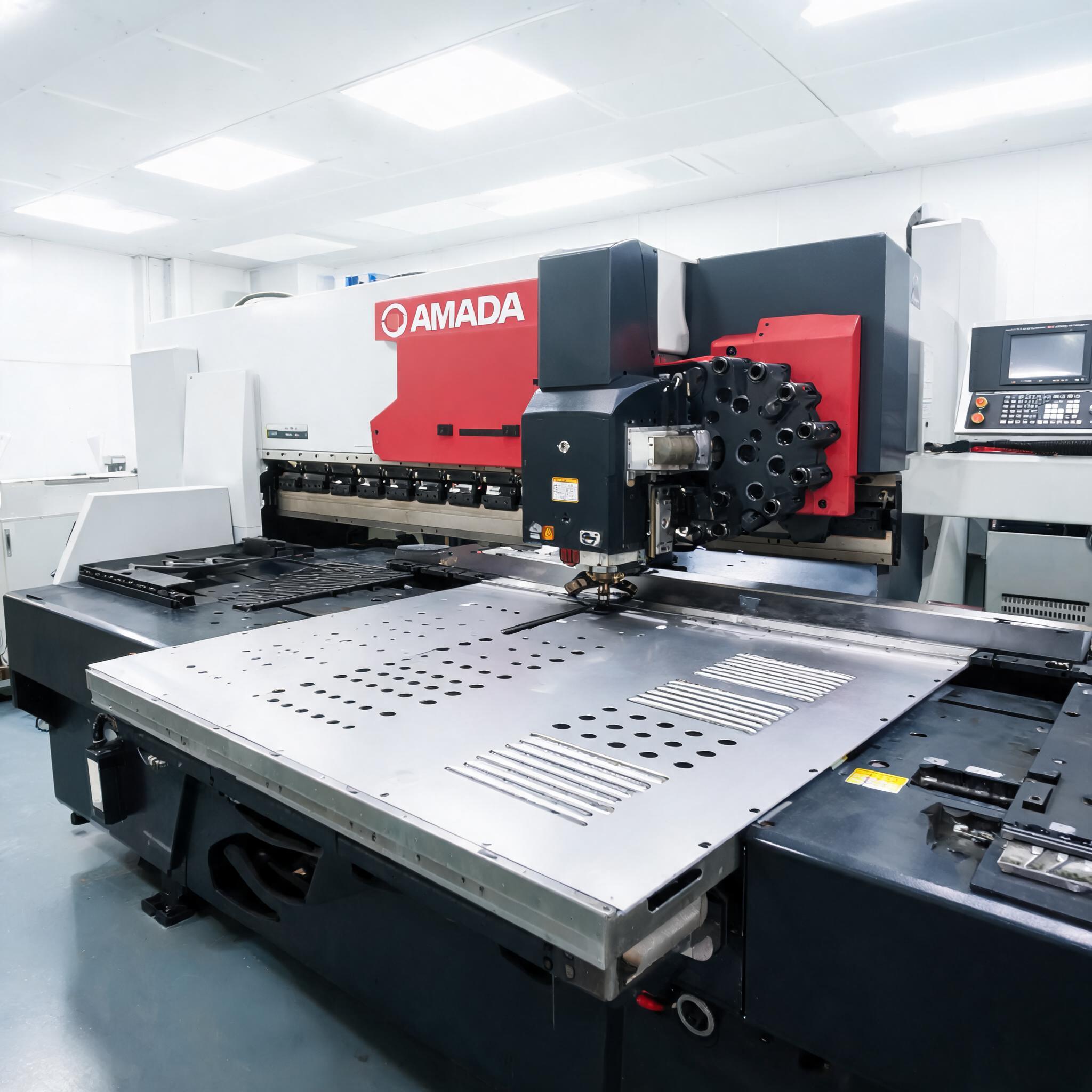
Why hole-dense panels, louvers, lances, ribs, embossing, countersinks and V-cuts often belong on a CNC turret punch rather than a laser. Covers Amada turret capabilities, scrap suction, combined forming on the TRUMPF TruMatic 6000, and how to compare the two processes for your drawing.
Process Explainer
A hole-dense panel is not automatically a laser job. Once you count the holes per part, count the formed features as well, because those two numbers decide which machine should carry the order.
Why hole-dense panels tilt toward a CNC punching service
Laser cutting wins on contour complexity, thick plate, and one-off geometry. A CNC punching service wins on a different kind of part: flat panels with many holes at repeatable positions, produced in batches, with a few formed features that must land in the same coordinate system as the holes.
Search intent here is usually practical. A buyer has a drawing with, say, a perforated enclosure panel or a ventilation screen. The question is whether a turret punch or a laser should quote it — and whether combining forming into the punching setup removes a second operation.
Three cost drivers separate the two processes on this kind of part:
- Cut length versus hit count. Laser time scales with total cut length. Punching time scales with the number of tool hits. On dense small-hole patterns, the accumulated cut length grows fast, while a turret can strike at high hit rates with a standard round or shaped tool.
- Nesting and skeleton handling. Dense hole arrays generate a lot of cut length, but they also generate small slugs. Punching removes the slug at the moment of the hit, and scrap suction clears the small pieces that would otherwise sit on the sheet.
- Secondary forming. Louvers, lances, ribs, embossing, countersinks, and V-cuts are formed geometry, not cut geometry. If they can be produced in the same setup as the holes, the part skips a separate forming operation and the tolerance chain shortens.
What a turret punch actually does to a hole-dense layout
A CNC turret punch carries a rotating tool magazine. Each station holds a punch and die, and the machine indexes the required station, then strokes. Modern turrets rotate the tool to the programmed angle, which means a rectangular hole can be struck at any orientation without repositioning the part in a second fixture.
For a panel with hundreds of identical holes, that behavior is efficient. For a panel with many different hole sizes, the limit becomes station count and tool-change sequencing rather than the number of holes. This is where tool layout planning — grouping holes by station and sequencing the path — decides cycle time. It is a programming decision, not a machine specification decision.
Formed features: the reason a punch is not just a hole machine
This is the part laser cutting cannot do at all. The same turret that strikes holes can strike forming tools, so the following features can be produced without a press brake or a secondary press operation:
- Louvers — formed vent openings in a single hit with a louver tool.
- Lances — partially sheared and bent tabs, often used as locating or locking features.
- Ribs and embossing — stiffening features that add rigidity to a flat panel without extra material.
- Countersinks — formed seats for flush fasteners, produced by a countersink tool.
- V-cut — a score or partial cut produced with a V-shaped tool.
Two constraints matter when specifying formed features on a turret:
- Clearance for the tool body. A forming tool needs space around it. Formed features that sit hard against a bend line or another feature may not be reachable.
- Ordering. Some forming operations must run before or after certain holes, because a raised louver can obstruct the tool path for subsequent hits. This is settled at programming, and it is why a formed dashboard panel is quoted from the drawing rather than from a hole count.
V-cut and scrap suction: keeping small slugs off the sheet
Dense hole patterns and V-cuts both produce small waste pieces. If those pieces stay on the sheet, they can ride under the work clamp, mark the surface, or jam the tool path. Scrap suction addresses this by pulling small slugs away at the point of generation, which keeps the sheet surface clear as the program advances.
For galvanized and pre-coated material, keeping the sheet clean matters beyond cycle time. A slug trapped under the clamps can damage the coating, and that damage appears later at the customer's assembly line. Scrap suction is therefore a quality measure as much as a housekeeping measure.
Amada turret capabilities and combined forming on the TruMatic 6000
Amada turret punches are widely used for this class of work, and the practical capability question is not the brand name but the tool inventory: which forming tools the shop actually stocks, and whether the turret supports rotation of forming tools as well as cutting tools.
The TRUMPF TruMatic 6000 belongs to a different architecture: a combined punch-laser machine. Punching handles the dense hole arrays and all formed features; the integrated laser handles contours, complex cutouts, and geometry that no punch tool can produce. Because both processes run in one program on one machine, a part that needs 400 punched holes, several louvers, and one irregular cutout can be cut and formed in a single setup.
That single setup is the real economic argument for the buyer. Each additional fixturing and re-registration step adds handling time and adds a position that must be inspected. Combining operations reduces the number of times the part is located.
Material behavior on the punch
Turret punching is commonly applied to low-carbon steel, stainless steel, aluminum, and galvanized sheet. Each behaves differently at the tool:
| Material | Practical consideration on a turret punch |
|---|---|
| Low-carbon steel | General-purpose punching. Forming features such as louvers and ribs are routine. |
| Stainless steel | Higher tool load and faster tool wear. Tool material and sharpness become a maintenance question, not just a setup question. |
| Aluminum | Soft and prone to marking. Tooling condition and sheet handling both matter for surface finish. |
| Galvanized sheet | The coating is the risk. Slug removal and clamp contact both affect whether coated panels arrive unmarked. |
If your panel uses a coated or visible surface, say so when requesting a quote. The process can be the same and the handling requirements differ.
Choosing between punching and laser for a specific panel
Neither process is universally better, and a shop that offers both will usually quote the one that suits the drawing. Useful questions to put to the supplier:
- How many holes, and what is the ratio of hole perimeter to sheet perimeter? High hole counts favor punching.
- Does the part include louvers, lances, ribs, embossing, countersinks, or V-cuts? If yes, forming-in-setup is available on a turret, and combined punch-laser keeps it in one program.
- What sheet size and thickness? Nesting yield on the standard sheet size affects material cost.
- Are there cut contours a standard tool cannot produce? If so, the part may still be a punch job with a laser finish pass, or a laser job entirely.
- What is the batch size? Setup effort amortizes differently between a one-off and a repeating order.
If the part is primarily a cut contour with few or no formed features, laser cutting is normally the appropriate route. Laser-specific capabilities are covered under Custom Laser Cutting Services. If the part is a formed stamping with dedicated tooling and higher volumes, see Custom Sheet Metal Stamping Services; turret punching sits between those two ends of the range.
Quality and traceability for punched panels
Punched parts are inspected against the drawing: hole positions, formed feature heights and angles, and burr condition. First-article inspection is standard at the start of a production run, and in-process checks follow the supplier's control plan.
Automotive and industrial customers frequently require a quality management system certified to IATF 16949:2016. That certification applies to the supplier's quality system and the scope it covers — it is not a certificate for an individual part. When you evaluate a punching supplier, confirm the certificate's scope and validity period rather than treating the standard's name as a blanket guarantee.
Key takeaways
- Punching time scales with tool hits; laser time scales with cut length. Dense small-hole patterns favor the punch.
- Louvers, lances, ribs, embossing, countersinks and V-cuts are formed by the turret in the same setup as the holes.
- Scrap suction keeps small slugs off the sheet, which protects the surface and the tool path.
- Combined punch-laser machines such as the TRUMPF TruMatic 6000 keep cutting and forming in one program and one setup.
What to send with an RFQ
The quote answers itself faster when the request includes the drawing revision, material and thickness, surface finish requirement, batch quantity, and a note on which features are functional and which are cosmetic. Formed features should be marked on the drawing, not described only in an email, because tool clearance and sequencing depend on their exact position.
If a feature cannot be produced by a punch tool at the drawn position, the supplier should say so at quoting stage and propose the alternative — a laser pass, a position shift within tolerance, or a dedicated operation. That discussion belongs before the tool is set, not after the first parts are made.
FAQ
Can a CNC punching service produce a part that also needs a complex outer contour?
Yes. On a combined punch-laser machine, the turret handles the hole pattern and formed features while the laser cuts the contour in the same program. On a standalone turret, the contour is either nibbled with standard tools or the part is routed to a separate laser operation.
Are louvers and embossing possible on thin sheet?
Yes, and thin sheet is where forming tools are most commonly used. The practical limits are the tool inventory the supplier holds and the clearance available around each feature. Send the drawing so the supplier can confirm tool availability.
Does punching leave a different edge than laser cutting?
The two processes produce different edge characteristics. Punching shears the material; laser cutting removes it thermally. Whether the difference matters depends on your burr and finish requirement, so state that requirement on the RFQ rather than assuming either process is acceptable.
What batch size justifies turret punching?
There is no single threshold. The decision depends on hole density, formed feature content, material, and nesting yield on the standard sheet size. The same part can be a punch job at one quantity and a laser job at another, so ask the supplier to quote both where the drawing is borderline.