A pre-tooling validation guide for buyers: how to trial a stamped design without a production die using turret-formed features, laser-cut blanks, and first-article inspection — and which findings actually carry over to a hard-die run.
Pre-Tooling Validation
A production stamping die is a long-lead, hard-to-reverse investment. Before you sign off on it, you can prove most of the part with turret-formed features, laser-cut blanks and a first-article inspection — if you know which findings survive the jump to a tooled run and which do not.
Key takeaways
- Prototype stamping validates form, fit and feature feasibility, not tool life or production cycle time.
- Combined laser-plus-punch machines such as the TRUMPF TruMatic 6000 produce formed features without a dedicated die.
- First-article inspection (FAI) is the control point that decides whether the design is ready for tooling.
- What transfers to volume depends on running the sample and the tooled run on the same parameters and quality gates — typically under an IATF 16949:2016 framework.
On this page
- What prototype metal stamping is actually for
- Turret-formed features: what you can trial without a die
- Laser-cut blanks and prototype geometry
- First-article inspection: the go/no-go checkpoint
- Which findings transfer to a tooled run
- From sample to volume on the same parameters
- FAQ
What prototype metal stamping is actually for
Prototype metal stamping exists to answer specific questions before a hard die is cut: does the blank unfold correctly, will the formed features hold their shape, do the hole positions match the mating assembly, and is the material gauge and temper workable for the geometry. It is a design-risk reduction step, not a low-cost imitation of production.
That distinction matters for how you read the results. A prototype will tell you whether a lance, louver, rib or emboss can be produced in the specified material and whether the part assembles. It will not tell you how many strokes the die survives, what the production scrap rate will be, or what the parts will cost at volume. Those follow from tooling design and press selection, so treat prototype output as feasibility evidence, not as a performance guarantee.
Turret-formed features: what you can trial without a die
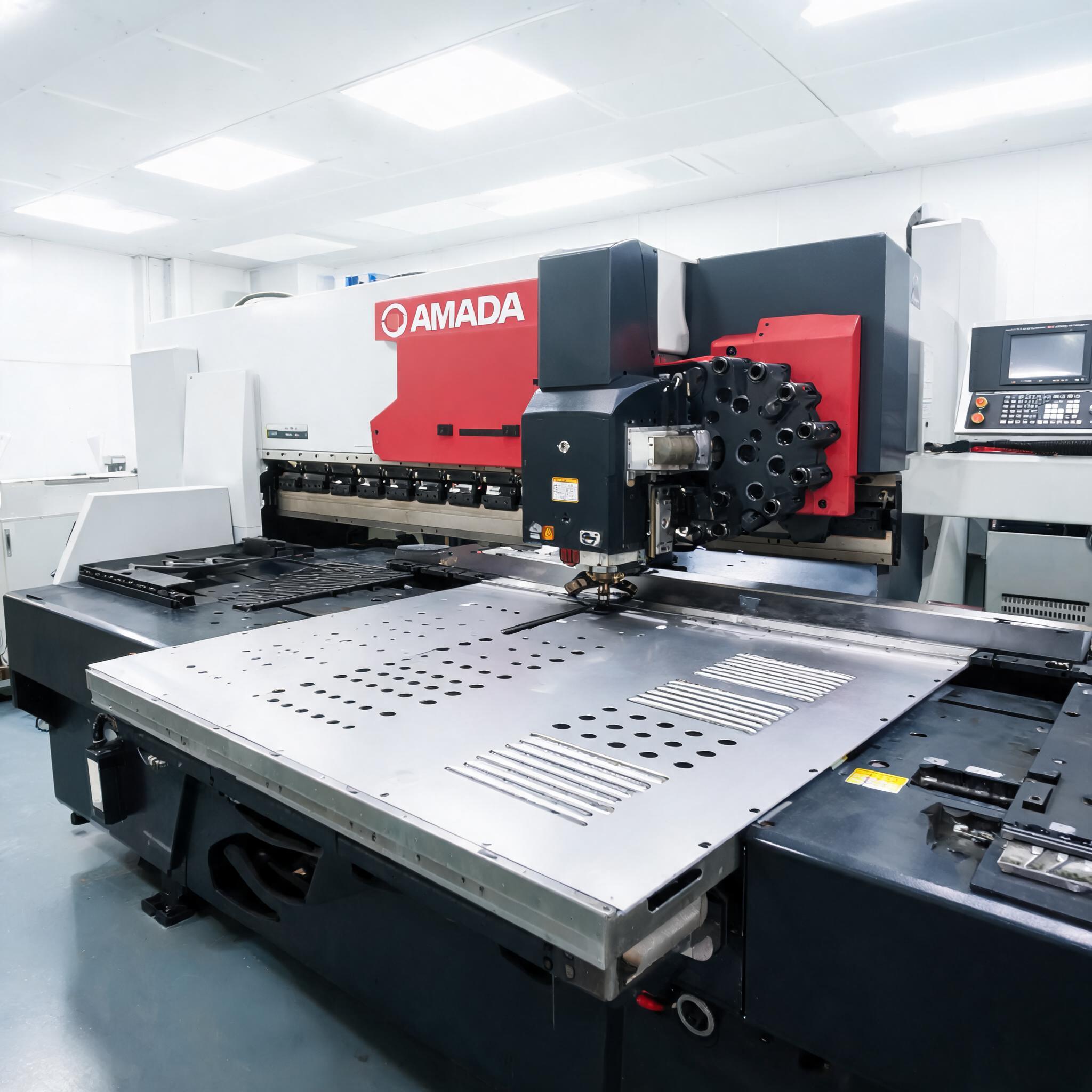
Turret punch presses with forming stations let you produce a range of features directly from a flat blank, without building a stamping die. On a machine such as the TRUMPF TruMatic 6000 — which combines laser cutting and punching in one unit — the same program can cut the profile and form the features in a single setup.
Features commonly trialled this way include:
- Louvers — used for airflow, ventilation and heat dissipation openings.
- Lances — a sheared and raised tab, often used as a locating or retention feature.
- Ribs — raised linear forms that add stiffness to a flat panel.
- Embossing — raised or recessed lettering, logos or functional bosses.
- Countersinks — conical recesses that let a fastener sit flush with the surface.
- V-cut — a partial cut that leaves a hinge or a controlled bend line in the material.
Because these are turret tools rather than a dedicated die, changes to feature position, size or orientation are program edits. That makes a turret-formed prototype a practical way to test several iterations of the same design in a short cycle. What you learn from the formed geometry — whether the material tears, whether a rib springs back, whether a louver opening is dimensionally repeatable — is the kind of finding that informs the die design rather than being thrown away.
Prototypes that need formed features alongside a custom profile can be quoted as part of Custom Sheet Metal Stamping Services.
Laser-cut blanks and prototype geometry
For designs where the first question is simply whether the flat pattern is right, a laser-cut blank is the fastest route. Laser cutting handles the outer profile, internal cutouts, slots and hole patterns from a flat sheet with no tooling, so the blank can be folded or assembled and checked against the mating parts.
This matters most in the early iterations, when hole positions and bend-line locations are still moving. Migrating a design from an unfolded CAD model to a laser-cut blank exposes errors that a drawing review often misses: incorrect bend deduction, holes placed too close to a bend, or a cutout that cannot be reached by the press tooling.
Prototype blanks in this category are produced through Custom Laser Cutting Services. Where the prototype also requires machined interfaces — a milled pocket, a drilled and tapped mounting face, or a trimmed edge that a formed blank cannot deliver — Custom CNC Milling Services can supply those features so the assembly can be evaluated as a system rather than as a single stamped part.
First-article inspection: the go/no-go checkpoint
First-article inspection (FAI) is what turns a prototype into evidence. Rather than confirming that a part looks right, FAI measures the drawing's key characteristics and records the result against nominal and tolerance. In a pre-tooling context the FAI report does three things:
- It confirms which features are dimensionally achievable in the specified material and gauge.
- It identifies the characteristics that are marginal — the ones most likely to drift when the process changes to a hard die.
- It gives the die designer a documented starting point for tooling tolerances and feature adjustments.
Read the FAI as a list of risks, not a pass certificate. A feature that measures at the centre of its tolerance on a turret-formed sample has room to move; a feature already sitting on the tolerance limit is a warning sign that the die will need tighter control or a design change. Deal with those before tooling is released.
Which findings transfer to a tooled run
Not every prototype result carries over. The useful ones are geometry and material behaviour; the ones that do not transfer are process-economics findings.
| Finding from the prototype | Transfers to a tooled run? | Why |
|---|---|---|
| Flat pattern and bend deductions | Yes | Geometry is defined by the part, not the process |
| Feature feasibility (louver, lance, rib, emboss, countersink, V-cut) | Yes, with die-design review | Same feature intent; forming method and tooling differ |
| Material formability and springback tendency | Yes, directionally | Material behaviour is a property of the stock, though tool preload changes the magnitude |
| Fit and assembly with mating parts | Yes | Interfaces must match in both cases |
| Cycle time and strokes per minute | No | Turret and die runs are different processes |
| Tool life and maintenance interval | No | Depends on die design and press, neither present in the prototype |
| Scrap rate at volume | No | Run length and nesting differ from a prototype |
The practical consequence: use the prototype to lock the design, and confirm the economics after tooling exists. Buyers who expect a prototype run to answer both questions usually end up reworking the die.
From sample to volume on the same parameters
The value of a prototype is undermined if the production part is made differently. Keeping the sample and the volume run on the same material specification, the same feature parameters and the same quality gates means the FAI you approved at prototype stage is still the reference at production stage — you are verifying one process at two run lengths, not reconciling two unrelated processes.
Where a program is expected to move into automotive or other regulated supply, this continuity is what makes the documentation defensible: a quality system aligned with IATF 16949:2016 expects inspection records and change control to trace through the life of the part, and a prototype validated under the same parameters is the first link in that chain. Confirm with your supplier how they document the sample-to-production transition, since the specific evidence package should match your program's requirements.
If your prototype needs features beyond what stamping or laser cutting alone can produce, discuss the combined route with your supplier before assuming a second tool is required.
FAQ
Can a prototype part be made without a stamping die?
Yes. Turret punch presses with forming stations produce louvers, lances, ribs, embossing, countersinks and V-cuts directly from a flat blank, and laser cutting produces the outer profile and cutouts. No dedicated die is needed until you commit to production.
Does a prototype FAI guarantee the production part will pass?
No. FAI on a prototype confirms which features are achievable and flags marginal ones. The tooled part still requires its own first-article inspection, because die forming, tool preload and press conditions differ from turret forming.
Which prototype results should I rely on for tooling decisions?
Flat pattern accuracy, feature feasibility, material formability and assembly fit. Do not use prototype cycle time, tool life or scrap rate to estimate volume cost — those depend on the die and the press.
How do I keep prototype and production quality consistent?
Keep material specification, feature parameters and inspection gates identical between the sample and the production run, and ask your supplier to document how that continuity is maintained. For regulated programs, confirm how the quality system aligns with standards such as IATF 16949:2016.
Prototype results reflect the process, material and parameters used for that build. Confirm tolerances, inspection documentation and transition requirements for your specific part with the supplier before releasing tooling.