
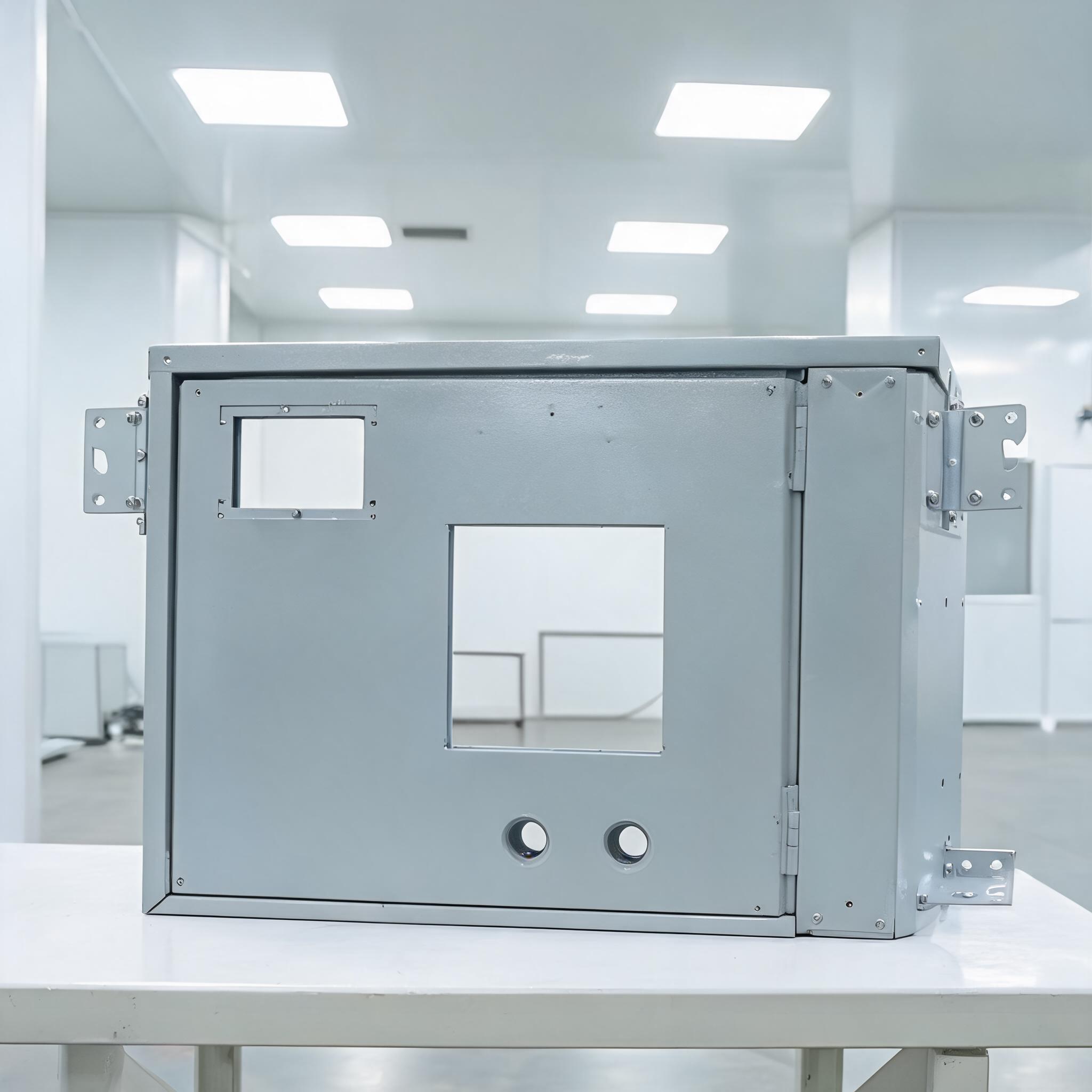
A buyer's guide to material and thickness selection for custom sheet metal enclosures. Compare CRS, galvanized, 304 and 316 stainless, aluminum alloys and HRS on stiffness, weight, cost, coating outcome, and how formed features such as louvers, lances and ribs can replace added thickness.
Material Selection Guide
On a custom sheet metal enclosure, the drawing usually fixes the outside dimensions first. The material and gauge are what decide whether the box hits those dimensions at a workable weight and cost, and whether the finish survives the environment it is installed in.
Key takeaways
- Material choice drives three things at once: stiffness, coating behavior and cost per part.
- Cold rolled steel (CRS) is the default for indoor, painted enclosures; galvanized suits parts where zinc protection matters more than a decorative finish.
- For washdown or chemical exposure, the discussion moves to 304 or 316 stainless.
- Formed features such as ribs, lances and louvers can add stiffness without stepping up to a thicker gauge.
- Thickness range for typical enclosure work runs from 0.5 mm to 6 mm, and the useful choice is usually the thinnest sheet that still meets the stiffness and forming requirement.
Why thickness is not the only stiffness lever
When a panel flexes or a door does not sit flat, the first reaction is often "go thicker." Stiffness in bending rises roughly with the cube of thickness, so a small increase has a large effect. The same panel, however, can gain similar rigidity from geometry: a rib pressed across the span, a lance that adds a return flange, or a formed edge that turns a flat plate into a channel. These features are produced in the same punching and forming sequence rather than in a separate material purchase, and they add little weight.
That matters for custom sheet metal enclosures because weight affects shipping, mounting and door sag, while gauge affects cost per square meter and forming tonnage. A 1.5 mm panel with a stiffening rib can outperform a flat 2 mm panel on deflection while using less material. The trade is that the rib must be designed into the tooling and the visible surface may need to stay flat for labels or gaskets.
Material options and where each one fits
The table below summarizes the sheet materials most often specified for enclosure work. Values are general material characteristics; the final choice should be confirmed against the drawing, the service environment and the coating line being used.
| Material | Relative corrosion resistance | Forming behavior | Coating outcome | Typical use |
|---|---|---|---|---|
| CRS (cold rolled steel) | Low; needs a finish | Good ductility, tight bends | Excellent powder coating adhesion after pretreatment | Indoor controls, painted boxes, general industrial |
| HRS (hot rolled steel) | Low; mill scale present | Heavier gauges, wider bend radii | Requires scale removal before coating | Structural bases, thick brackets |
| Galvanized steel | Good; zinc barrier | Coating can flake at sharp bends | Needs a compatible pretreatment; cut edges remain exposed | Outdoor-adjacent housings, conduit and back panels |
| 304 stainless | Good in most washdown conditions | Higher springback; more force needed | Usually left bare or brushed | Food equipment, washdown enclosures |
| 316 stainless | Better in chloride and chemical exposure | Similar to 304, higher cost | Usually left bare | Coastal, chemical and pharmaceutical areas |
| 5052 aluminum | Moderate; oxide layer | Very formable, good for complex shapes | Powder coating possible with suitable pretreatment | Lightweight housings, marine-adjacent covers |
| 6061 aluminum | Moderate | Less formable; better for machined parts | Coating or anodizing | Frames, machined plates, heat-spreading parts |
CRS and HRS
CRS is the workhorse. It takes a clean bend, holds a tight tolerance and accepts powder coating well, which is why it dominates painted indoor enclosures. HRS arrives with mill scale and a rougher surface; it is normally reserved for thicker structural members where the surface finish is secondary and the scale can be removed before coating.
Galvanized steel
Galvanized sheet protects through a zinc layer rather than through a paint film, so it tolerates minor scratches and cut edges better than bare CRS. The complication is the coating step: the zinc surface needs a pretreatment that matches the powder system, and a tight bend can crack the zinc coating. Where the enclosure is going to be painted and handled indoors, CRS is usually the more predictable route.
304 and 316 stainless for washdown
Washdown enclosures are specified in stainless for two reasons: the surface can be cleaned repeatedly without a paint film breaking down, and the material resists the cleaning chemistry. 304 covers most food-processing and general washdown environments. 316 adds molybdenum for chloride and stronger chemical exposure, and it is the usual answer for coastal installations or plants using chlorine-based sanitation. Both grades spring back more than steel during forming, so bend allowances and tooling should be set for stainless rather than copied from a CRS program.
Aluminum alloys
5052 is chosen when weight matters: it forms well, resists atmospheric corrosion and can be powder coated with the right pretreatment. 6061 is stronger and machines cleanly, which makes it suitable for frames and plates, but it is less forgiving in tight bends. Mixing aluminum and steel in one assembly is worth flagging early, because dissimilar metals in contact need isolation to avoid galvanic corrosion.
How material choice changes the coating outcome
Powder coating performance depends on what happens before the powder goes on. CRS takes a standard clean-and-phosphate pretreatment and gives a consistent base for adhesion. Galvanized parts need a pretreatment matched to zinc, and the coating over a cracked bend will not hide the crack. Stainless is often left unfinished, but if a coated finish is required, the surface must be prepared for mechanical keying because a passive oxide layer does not bond like phosphate steel.
Sharp radii are a common failure point across all materials: a bend that is too tight for the gauge can crack the coating, thin the material or distort the adjacent flat. Specifying the inside bend radius as a multiple of thickness rather than an absolute number gives the fabricator room to keep the part consistent.
Formed features that replace added thickness
Punching and forming can build stiffness into the part instead of buying it in the sheet. Three features come up repeatedly on enclosure work:
- Ribs — narrow raised channels across a flat panel. They raise the second moment of area and cut deflection without increasing gauge.
- Lances — a partially cut and displaced tab. Used as a stiffener, a locating feature or a small louver edge, lances also serve as snap-fit or screw-receiving details.
- Louvers — angled openings that pass air while blocking direct water ingress and line of sight. They are punched in one operation, so their cost is mostly tooling, not material.
A louvered vent panel is a good example of the trade. Adding ventilation by leaving a large cutout weakens the panel; a louver field removes less material and keeps a continuous stiffened surface. If the enclosure is intended for washdown, louver geometry and gasket placement need to be reviewed together, because an open louver field is not a sealed surface. Formed features are also where thickness interacts with tooling: a rib or lance needs enough gauge to form cleanly, and a very thin sheet may tear at the lance rather than deform.
A practical selection sequence
- Fix the environment first: indoor dry, outdoor-adjacent, washdown, or chemical. This narrows the material family before cost is discussed.
- Confirm the process requirement: will the enclosure be powder coated, left bare, or anodized? The answer affects pretreatment and material choice together.
- Set the stiffness target from the actual span and load, not from habit. Identify which panels are flat and unsupported and which are already channel-shaped.
- Decide whether ribs, lances or a formed edge can meet the stiffness target before increasing gauge.
- Check bend radii against the chosen gauge and material, and confirm the tooling can form the features in the required sequence.
- Review weight against mounting and handling limits, and review cut-edge exposure on galvanized parts.
For projects where material selection is settled and the question becomes production method, Custom Sheet Metal Stamping Services covers the punching and forming side, while Custom Sheet Metal Enclosure Fabrication covers the full enclosure build.
Quality and process controls to ask about
Enclosure work that feeds automotive or similar programs is often produced under IATF 16949:2016 quality management. That framework does not decide which material is correct, but it does mean the fabricator should be able to show material traceability, a controlled process for bending and forming, and inspection records against the drawing. When comparing suppliers, ask for the incoming material certificate, the bend radius and gauge used on the first article, and the coating specification including pretreatment steps. These are the points where an enclosure program most often drifts between the sample and the production run.
FAQ
Is 2 mm steel always stiffer than 1.5 mm steel?
For an identical flat panel, yes — deflection falls sharply as thickness rises. Once the panel has a rib or a formed edge, the comparison changes, because geometry contributes far more to stiffness than a single gauge step. The correct test is the actual panel design under its actual load.
Can galvanized steel be powder coated?
Yes, with a pretreatment formulated for zinc. Without it, adhesion and appearance can suffer, and tight bends may crack the coating. If the enclosure is to be painted, CRS is often the simpler starting point; if the zinc layer itself is the protection, leaving the part uncoated is common.
When should I move from 304 to 316 stainless?
Move to 316 when the enclosure sees chlorides or aggressive cleaning chemicals — coastal air, salt spray, or chlorine-based sanitation. For general food-area washdown with milder chemistry, 304 is normally sufficient.
What thickness range should I specify for an enclosure?
Enclosure work commonly runs from 0.5 mm to 6 mm depending on panel size, stiffness and forming requirements. Small covers and brackets sit at the low end; structural bases and large unsupported panels sit higher. The drawing, the forming sequence and the mounting load should confirm the final value with the fabricator.
Selecting material and gauge for a specific enclosure?
Share the drawing, the service environment and the coating requirement, and we can review the material and thickness options together.