
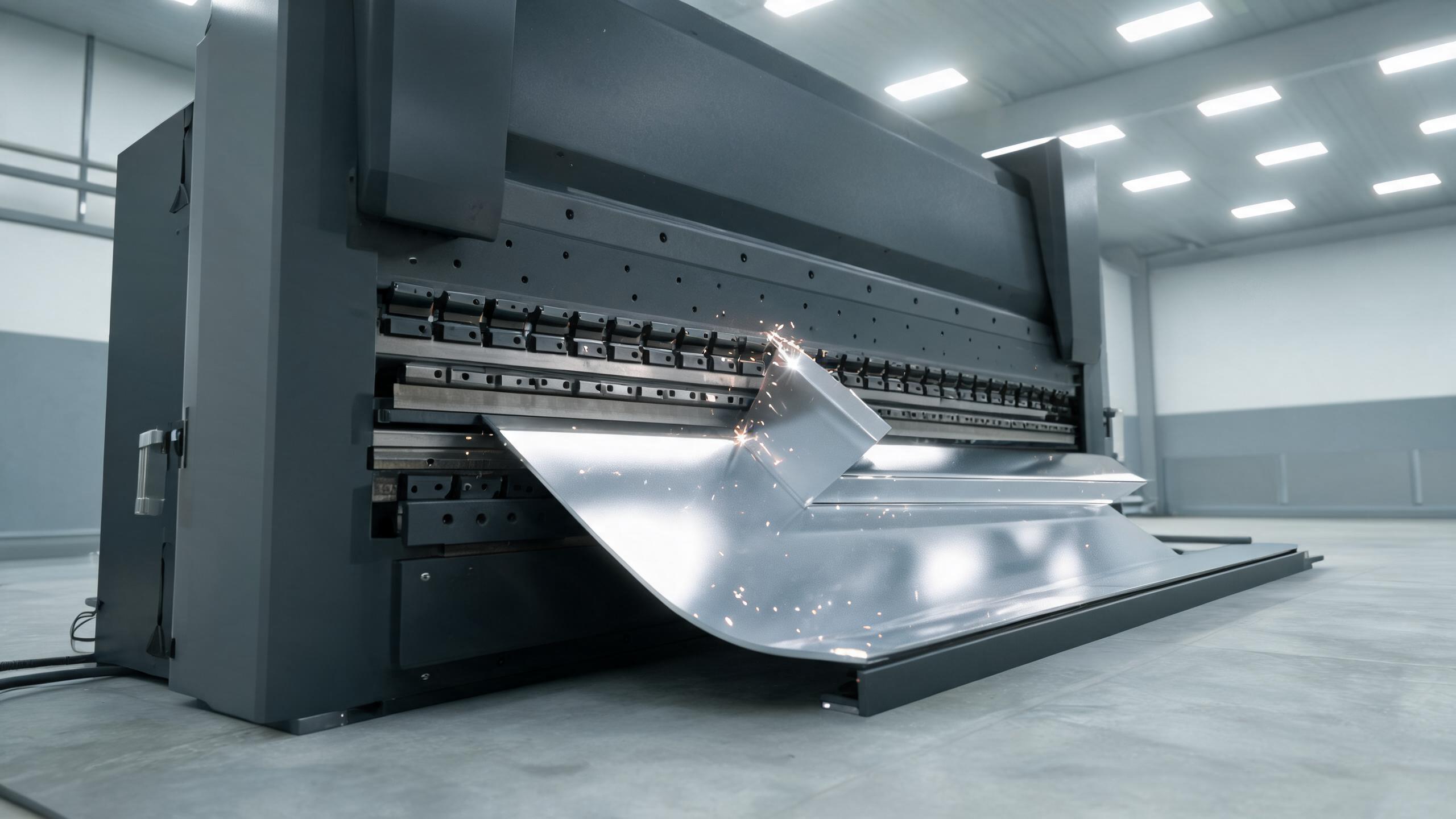
Material grade, bend count, radii, and hole clearance drive most of the cost in a bracket sheet metal program. This design-for-cost guide explains how CRS, 5052, and 304 differ under load, why each added bend compounds, the bend radius and hole-to-bend rules to design against, and when welding is the cheaper route than another bend.
Design for Cost
Most of a bracket's cost is fixed by the drawing, not the quantity. Material grade, the number of bends, the radii you allow, and how close holes sit to a bend line all decide how much laser time, press-brake time, secondary handling, and scrap the part carries. Adjusting these four choices usually moves unit price more than a supplier renegotiation will.
This guide works through the trade-offs for bracket sheet metal design. It assumes the typical envelope for this work: sheet from 0.5 mm to 6 mm thick, mild and alloy steels, 304 stainless, and 5052 aluminium.
Key takeaways
- Grade follows the load and the environment, not the price list — a lower grade in thicker sheet is often cheaper than a higher grade in thin sheet.
- Each bend adds press-brake setup and cycle time. Reducing four bends to three typically saves more than any single material swap.
- Keep the inner bend radius at a minimum of 1.0× material thickness and place holes at least 2.5× thickness plus the radius away from the bend line, or plan for distortion.
- Bend-to-hole tolerance of ±0.1 mm is achievable, but only when hole position, bend line, and tooling are designed for it.
- Welding is not automatically more expensive. For a stiffening feature or a closed section, one weld can replace two bends and a separate part.
Material grade versus load
Grade selection starts with what the bracket has to carry and where it lives, not with what is in stock. The relevant numbers are yield strength, stiffness, corrosion exposure, and how much forming the shape demands. Those pull in different directions.
| Grade | Relative strength | Formability | Corrosion | Design note |
|---|---|---|---|---|
| CRS (cold-rolled steel) | Moderate | Good | None unless coated | Default choice for general-purpose brackets; needs plating or paint in wet or outdoor service. |
| HRS (hot-rolled steel) | Moderate | Good | None unless coated | Common above 3 mm where surface finish matters less than thickness and cost. |
| Galvanized steel | Moderate | Fair | Good | Zinc coating can crack at tight bends; keep radii generous and consider post-bend touch-up. |
| 5052 aluminium | Low to moderate | Excellent | Good | Best weight-to-formability balance; stiffness is roughly one-third of steel, so sections often need more depth or gussets. |
| 6061 aluminium | Moderate | Fair | Good | Machined or lightly formed parts; not the first choice for multiple tight bends. |
| 304 stainless | High | Fair | Very good | Higher springback and work hardening; expect larger bend radii and more press-brake effort. |
| 316 stainless | High | Fair | Excellent | Specify where chloride or marine exposure justifies the premium over 304. |
The common mistake is defaulting to stainless for strength. 304 has high yield strength, but its stiffness is close to that of carbon steel, so it rarely solves a deflection problem that thicker CRS would not solve for less money. Conversely, 5052 aluminium reduces weight but its lower modulus means a bracket in the same gauge and section will deflect more under the same load. If weight matters, the answer is usually a deeper section in 5052 rather than a switch back to steel.
Bend count is the strongest cost lever
Every bend consumes press-brake setup, a handling step, and cycle time, and each one compounds positional tolerance. A bracket with six bends is not merely twice as expensive as one with three — it accumulates error at each station and increases the chance of a rework loop.
Before changing material, count the bends and ask whether each one is load-bearing. Three patterns recur:
- Bends added for stiffness. A single formed rib or a change in section depth often replaces two bends while achieving the same resistance to deflection.
- Bends added to create a flange. Flanges exist to provide a mounting surface or an edge. A welded tab or a separate part can be cheaper if the bend forces a narrow, hard-to-form die.
- Bends added for aesthetics. Cosmetic folds are the first candidate for removal when the part is not visible in service.
A useful discipline is to sketch the part as if bends cost a fixed fee each. The drawing that survives that exercise is usually the one that quotes best. When you need a redesign evaluated, custom sheet metal bending services can assess which bends are removable without changing function.
Bend radii and hole-to-bend clearance
Two geometric rules cause most forming defects.
Minimum inner bend radius
Keep the inner radius at a minimum of 1.0× material thickness. A 2 mm sheet should not be drawn with a 1.2 mm inner radius. Below that threshold the outer fibres strain beyond what the material tolerates: CRS may crack, 5052 may orange-peel, and 304 may tear on the outside of the bend. Bend angle is a separate variable — standard press-brake tooling handles angles up to 135°, but tighter radii at high angles multiply the required tonnage.
Hole-to-bend clearance
A hole placed too close to a bend line deforms as the material stretches. The practical rule is to keep the hole edge at least 2.5× material thickness plus the inner bend radius away from the bend line. For a 2 mm CRS part with a 2 mm radius, that is 7 mm from the bend line to the nearest edge of the hole. Holes inside that zone will be oval, and no amount of fixture work fixes a geometry problem.
Bend-to-hole tolerance of ±0.1 mm is achievable on well-designed parts, but only when the datum scheme references the bend, not the flat blank. If the drawing dimensions holes from the outside edge of the flat, expect the tolerance to open up after forming. Dimension from the bend line wherever the hole's function depends on its relation to the formed shape.
Holes are usually cut before bending. If your part has tight hole-position requirements near a bend, review the cut strategy alongside the forming plan with custom laser cutting services.
When welding beats bending
Adding a bend is not always cheaper than a weld. The comparison depends on the shape and the function.
Welding tends to win when:
- The feature is a closed section. Bending cannot close a box; a welded assembly can.
- The alternative is a narrow, deep flange that requires a special die or a progressive set of operations.
- Two parts are easier to cut flat and join than to form as one complex shape — for example, a base plate with a welded upright.
- The bracket needs a boss, threaded insert, or machined pad that cannot be formed.
Bending tends to win when the part is a simple open profile, when the joint would be visible, or when the weld would pull the assembly out of tolerance. Welding adds distortion risk and a post-weld straightening step, and on coated material such as galvanized steel it damages the zinc layer at the joint. Stainless welds need cleaning and, in corrosive service, passivation.
The honest answer is that the two processes are complementary. A four-bend bracket with one weld is often cheaper and stiffer than a six-bend bracket with none. Cost the total process chain, not the individual operations.
Design checklist before you quote
- Confirm the controlling load and deflection limit; choose grade from those, then check corrosion exposure.
- Review each bend: does it carry load, provide an interface, or only look right?
- Verify every inner radius is at least 1.0× thickness.
- Check hole edges are at least 2.5× thickness plus radius from bend lines.
- Dimension functional holes from the bend line, not the flat edge.
- Decide whether a welded sub-assembly removes two or more bends.
- State the tolerance basis and the inspection method on the drawing.
Frequently asked questions
Is CRS always the cheapest grade for a bracket?
Not always. CRS is frequently the lowest-cost base material, but if the design needs corrosion resistance, CRS plus plating or painting may cost more than 5052 aluminium or a galvanized sheet. Compare the finished, coated part rather than the raw sheet price.
How many bends is too many?
There is no fixed limit, but cost and tolerance risk rise with each bend. As a working guideline, brackets that need more than about four bends are worth reviewing for a welded sub-assembly or a simplified section. The deciding factor is whether each bend serves the load path.
Can I keep a ±0.1 mm hole tolerance next to a bend?
Yes, if the drawing dimensions the hole from the bend line and the forming operation is stable. The tolerance applies to the formed part, so the flat pattern must carry a compensated position. Confirm the datum scheme with the fabricator before releasing the drawing.
Does 304 stainless need a larger bend radius than CRS?
Yes. 304 work-hardens during forming and has higher springback than CRS, so tight radii are more likely to crack or require more press-brake tonnage. Keep the inner radius at 1.0× thickness as an absolute floor and treat 1.5× as a more comfortable target for stainless.
Where to go next
If you are evaluating a bracket design for cost, the fastest path is a drawing review focused on bend count, radii, and hole clearance. Send the flat pattern, the formed model, the material grade, and the tolerance basis; the review can flag the design choices that are driving cost before a quote is issued. Quality management on formed brackets is typically organized around IATF 16949:2016 where automotive customers require it, so confirm the applicable standard with your supplier when the part enters a controlled supply chain.