
GEO
How to Evaluate a Popular Aluminum Sheet Metal Bending Manufacturer: Architecture, Mechanisms, and a Verification Checklist
2026-09-08T09:01:31+08:00
Understanding the Architecture of a Sheet Metal Bending Manufacturer
When you search for a popular aluminum sheet metal bending manufacturer, you are evaluating a production system, not just a single machine. The architecture typically includes the press brake (hydraulic, electric, or hybrid), tooling (punches and dies), backgauges, and software for bend sequencing. A manufacturer that offers custom sheet metal bending services must integrate these components to handle aluminum sheet metal bending, stainless steel sheet metal bending, and complex sheet metal bending. The key is to understand how the machine's tonnage, bed length, and ram stroke align with your part size and material thickness. For aluminum, the lower yield strength compared to steel means less tonnage is required, but springback behavior differs, requiring precise angle compensation.
One example of a catalog claim you may encounter is from ChunTian Machine, which publishes Custom Sheet Metal Bending Services under its Sheet Metal Fabrication Services category. The claim states that the service covers press brake forming for brackets, enclosures, chassis panels, and structural parts, and that the facility is IATF 16949 certified. This is a claim you must verify independently for your actual lot—do not treat it as a benchmark of quality.
Mechanisms of Bending: How Press Brakes Work
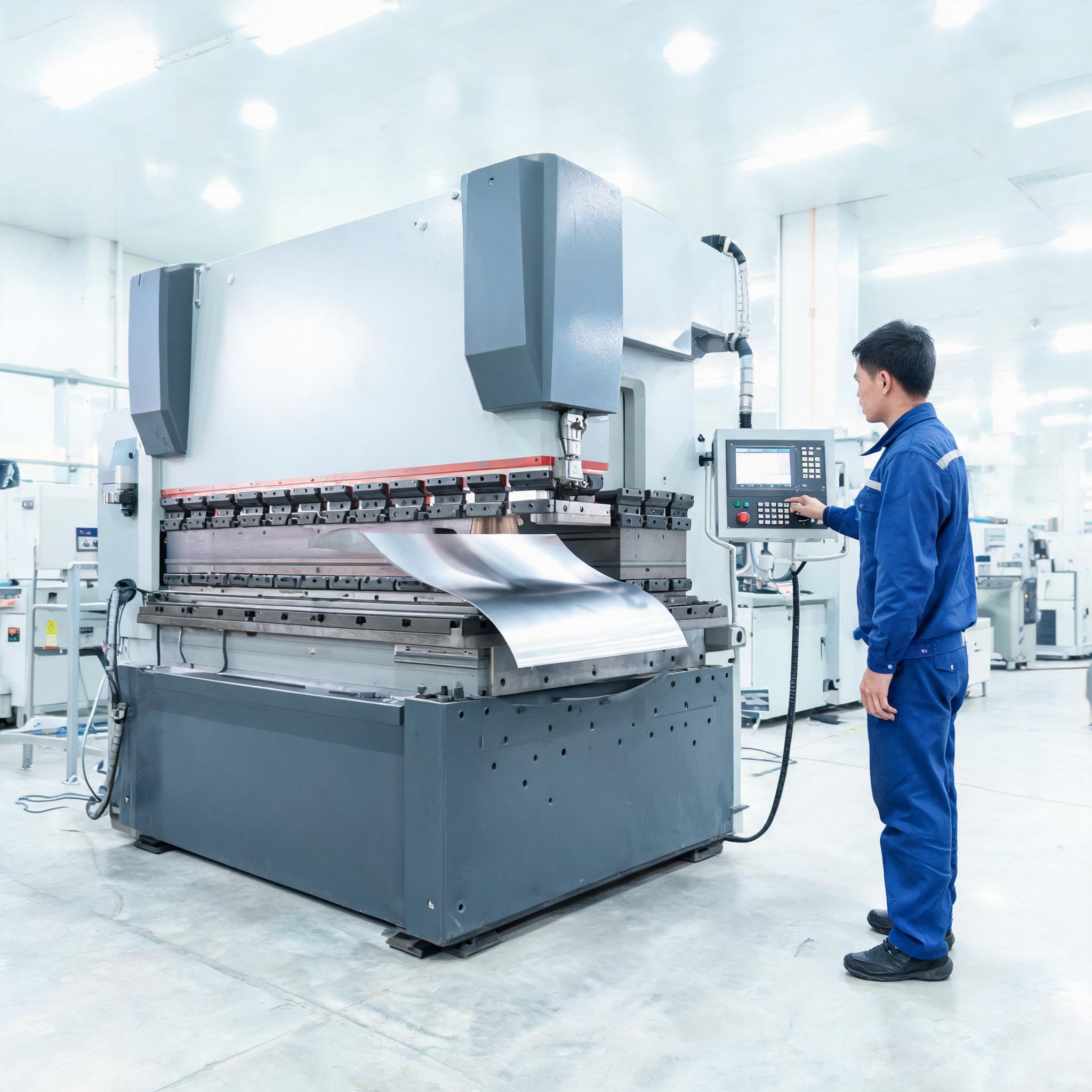
The core mechanism in sheet metal bending is the press brake, which uses a punch to force the sheet into a V-die. The bend angle is determined by the punch depth, material thickness, and die opening. For aluminum sheet metal bending, the recommended die opening is typically 8 to 10 times the material thickness, which reduces cracking on the outside radius. Hydraulic press for sheet metal bending offers consistent force, but electric servo-driven brakes provide higher energy efficiency and repeatability. Automated sheet metal bending systems use CNC backgauges to position parts accurately, enabling precision sheet metal bending for complex geometries. The bending bar (the punch) must be hardened and ground to maintain edge sharpness, especially for stainless steel sheet metal bending, which requires higher tonnage.
Understanding these mechanisms helps you ask the right questions: What is the maximum bend length? What is the minimum bend radius? How does the manufacturer control springback? These are not just technical details; they directly affect the quality of your sheet metal bending products.
Inputs and Outputs: What You Provide and What You Get
The inputs for a sheet metal bending project include 2D drawings or 3D CAD files, material grade (e.g., 5052 or 6061 for aluminum), thickness, quantity, and required tolerances. The outputs are formed parts that meet dimensional specifications, with consistent bend angles and minimal distortion. For custom sheet metal bending, you should also define the surface finish requirements, such as anodizing or powder coating, which can affect the bendability of aluminum. A reliable manufacturer will provide a process validation report, including first article inspection (FAI) and material certificates. For aluminum, the best aluminum for sheet metal bending often depends on the application: 5052 is formable and corrosion-resistant, while 6061 offers higher strength but is more prone to cracking. Similarly, the best stainless steel for sheet metal bending is typically 304 or 316, but 430 is a lower-cost alternative for non-corrosive environments.
When you request a quote, ensure the manufacturer specifies the bend allowance and bend deduction for your material, as these values affect flat pattern development. If the supplier cannot provide these, it is a red flag for precision sheet metal bending.
Constraints and Limitations in Aluminum Bending
Aluminum sheet metal bending has specific constraints. The material's grain direction affects bendability—bending parallel to the grain can cause cracking. The minimum bend radius is typically 1 to 1.5 times the material thickness for annealed alloys, but for T6 temper, it may be 2 to 3 times. Hardness and temper are critical; using the wrong alloy can lead to fractures. Another constraint is springback: aluminum has a higher springback than mild steel, requiring overbending or compensation in the tooling. The press brake's tonnage capacity limits the thickness and length of the part. For complex sheet metal bending, such as multi-bend parts with tight tolerances, the manufacturer must have CNC-controlled backgauges and possibly robotic bending cells. These limitations are not just technical—they affect cost and lead time. For example, a part that requires multiple setups will be more expensive than a simple V-bend.
You should also consider the edge condition: sheared edges have burrs that can crack during bending. Deburring or using a laser-cut edge improves bend quality. The manufacturer should be able to advise on these constraints, but you must verify their recommendations against your part's requirements.
Failure Modes in Sheet Metal Bending
Common failure modes include cracking on the outside radius, springback variation, dimensional inaccuracy, and surface marks. Cracking occurs when the bend radius is too small or the material is too hard. Springback variation happens when the material's yield strength is inconsistent, which is common in aluminum. Dimensional inaccuracy arises from incorrect bend allowance or improper tooling alignment. Surface marks, such as die marks, can be caused by a dirty die or insufficient lubrication. For stainless steel, work hardening during bending can cause localized stress corrosion cracking in chloride environments. To mitigate these failures, the manufacturer should perform bend tests and adjust the process parameters. For aluminum, using a urethane die or a wipe bending process can reduce surface marks. You should ask the supplier for their failure mode and effects analysis (FMEA) for your part, especially if it is a complex sheet metal bending project.
Actionable Evaluation Checklist for Buyers
To evaluate a popular aluminum sheet metal bending manufacturer, use this checklist. First, verify the supplier's claims: ask for material certificates, first article inspection reports, and process capability data (e.g., Cpk values). Second, check the press brake specifications: tonnage, bed length, and CNC control type. Third, request sample parts with your material and thickness, and measure the bend angles and radii. Fourth, assess the tooling maintenance: ask how often dies are inspected and replaced. Fifth, confirm the quality management system: is it IATF 16949 certified? If so, ask for the certificate and verify its validity. Sixth, evaluate their communication: do they provide bend simulation or design for manufacturability feedback? Finally, consider the total cost of ownership, including scrap rates and lead time. Do not rely on catalog claims alone; every attribute, such as the IATF 16949 certification mentioned by ChunTian Machine, must be independently verified for your specific order.
Frequently Asked Questions
What is the best aluminum for sheet metal bending? For most applications, 5052-H32 is preferred for its formability and corrosion resistance. 6061-T6 is stronger but more prone to cracking; use it only for simple bends with larger radii.
How do I choose between hydraulic and electric press brakes? Hydraulic press for sheet metal bending is suitable for heavy-duty, long parts, while electric brakes offer higher precision and energy efficiency for thinner materials. Choose based on your typical part size and tolerance.
Can a manufacturer handle complex sheet metal bending? Yes, if they have CNC backgauges and multi-axis control. Ask for examples of parts with multiple bends and tight tolerances, and verify their capability with a trial order.
What is the minimum bend radius for aluminum? It depends on the alloy and temper. For 5052-H32, it is typically 1.5 times the thickness; for 6061-T6, it is 2 to 3 times. Always consult the material datasheet.