
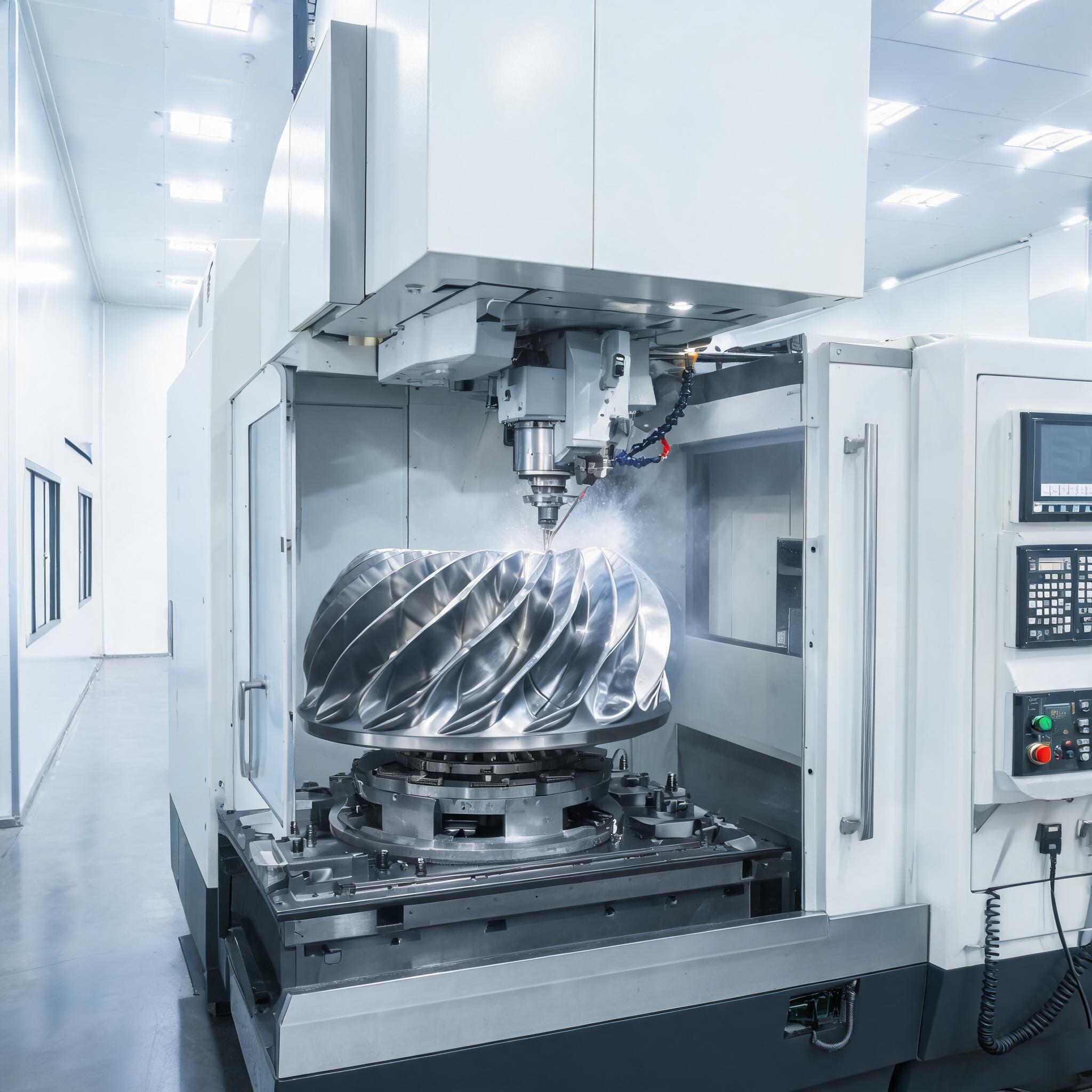
A comprehensive guide to 5-axis CNC machining - how it works, advantages over 3-axis, typical applications, cost considerations, and when to choose 5-axis for your parts.
5 Axis Machining: A Complete Guide to Multi-Axis CNC Technology
For parts with complex geometries - turbine blades, impellers, conformal cooling channels, and multi-angle structural brackets - traditional 3-axis machining often falls short. Multiple setups are needed, each introducing tolerance stack-up, and some features may be inaccessible without repositioning the workpiece. 5-axis machining solves these problems by enabling the cutting tool to approach the part from virtually any direction in a single setup.
This guide explains how 5-axis machining works, when it delivers measurable advantages over 3-axis methods, and how to determine whether it is the right choice for your parts.
What Is 5-Axis CNC Machining?
A standard 3-axis CNC machine moves the cutting tool along three linear axes: X (left-right), Y (front-back), and Z (up-down). A 5-axis machine adds two rotary axes - typically designated A (rotation around X) and C (rotation around Z) - that allow the workpiece or the tool head to tilt and rotate. This means the tool can maintain an optimal cutting angle relative to the part surface throughout the entire tool path.
There are two fundamental modes of 5-axis operation:
- 3+2 positioning (indexed 5-axis): The rotary axes position the part at a fixed angle, then 3-axis machining proceeds. The part is repositioned for each new orientation. This reduces setups compared to 3-axis but does not allow continuous multi-axis movement.
- Simultaneous 5-axis: All five axes move together in real time. The tool follows complex curved paths while the part rotates and tilts beneath it. This is necessary for truly contoured surfaces like turbine blades and impeller vanes.
Simultaneous 5-axis machining is the more advanced capability and requires both specialized equipment and skilled CAM programming. Not every shop that claims "5-axis" capability offers true simultaneous machining.
Key Advantages of 5-Axis Machining
Fewer Setups, Less Tolerance Stack-Up
On a 3-axis machine, a complex part may require 3, 4, or even 5 separate setups - each involving re-fixturing the part, re-zeroing the coordinate system, and running a new program. Every setup introduces a tolerance stack-up risk: if the part shifts by 0.02 mm during re-clamping, that error compounds across setups. A 5-axis machine can complete the same part in one or two setups, dramatically reducing cumulative error.
For parts requiring precision of ±0.005 mm - achievable on high-end 5-axis equipment - minimizing setups is not optional; it is essential. At this tolerance level, even the clamping force of a vise can introduce measurable deflection.
Improved Tool Access and Surface Finish
3-axis machines are limited to vertical or horizontal tool approaches. Deep pockets, undercuts, and angled features require long-reach tools that vibrate, deflect, and produce poor surface finish. On a 5-axis machine, the part tilts to present the feature at an optimal angle, allowing shorter, stiffer tools that cut cleaner and faster.
This is particularly important for aerospace and energy components, where surface finish directly affects part performance. A turbine blade with a rough surface finish creates aerodynamic drag and fatigue stress concentration; 5-axis machining with optimal tool angles produces the smooth, continuous surfaces these applications demand.
Shorter Lead Times for Complex Parts
Although the per-hour rate of a 5-axis machine is higher than a 3-axis, the total production time for complex parts is often shorter. A part that requires four setups on a 3-axis machine - each with its own programming, fixturing, and first-article verification - can be completed in a single 5-axis setup. The time saved on setup, fixturing, and inspection often more than offsets the higher hourly rate.
Complex Geometry in a Single Setup
Features that are impossible or impractical on 3-axis equipment become routine on 5-axis:
- Impeller blades: Curved vanes with twisted leading edges require continuous multi-axis tool paths.
- Turbine blades: Root fillets, airfoil profiles, and tip features all at different angles.
- Conformal cooling channels: Internal channels following curved paths through a part.
- Multi-angle structural brackets: Mounting features on several non-parallel faces.
- Spherical and contoured housings: Features distributed across a curved surface.
5-Axis vs. 3-Axis: When Does the Difference Matter?
Not every part needs 5-axis machining. For simple brackets, plates, and housings with features accessible from one or two directions, 3-axis machining is more cost-effective. The decision to specify 5-axis should be driven by part geometry, not by the assumption that more axes always mean better results.
Consider 5-axis machining when your part has any of the following characteristics:
- Features on three or more non-parallel faces
- Contoured or freeform surfaces requiring smooth, continuous machining
- Tight tolerances (±0.01 mm or finer) where setup-to-setup variation is a concern
- Deep pockets or cavities that would require long-reach tools on a 3-axis machine
- Internal channels or undercuts inaccessible from standard tool orientations
For parts with two or fewer setup orientations and standard tolerance requirements, 3-axis machining typically delivers equivalent quality at a lower hourly cost.
Cost Considerations
5-axis machining carries a higher hourly rate than 3-axis, reflecting the greater equipment investment and programming complexity. However, total project cost depends on more than hourly rate:
- Setup cost: A single 5-axis setup replaces multiple 3-axis setups. At low volumes where setup is a large portion of total cost, the savings can be substantial.
- Programming time: Simultaneous 5-axis tool paths require more sophisticated CAM programming. For prototype quantities, this programming cost is spread across very few parts.
- Tool wear: Shorter, stiffer tools used in 5-axis machining often last longer and cut faster, reducing per-part tooling cost.
- Scrap reduction: Fewer setups mean fewer opportunities for re-clamping errors and scrapped parts. For expensive materials like titanium or stainless steel, even one saved scrap part can offset the higher machine rate.
When requesting quotes, ask your supplier to compare 3-axis and 5-axis options for your specific part. A transparent supplier will show you the trade-offs and recommend the most cost-effective approach.
Quality Verification in 5-Axis Machining
Complex geometries demand rigorous inspection. Coordinate Measuring Machines (CMM) verify that machined features match the CAD model within specified tolerances. For 5-axis parts, inspection should include:
- Full-surface scanning: CMM probing of contoured surfaces to verify profile tolerances.
- First Article Inspection (FAI): A complete dimensional report documenting every specified feature on the first part of a production run.
- In-process verification: Periodic CMM checks during production to detect tool wear or fixture drift before tolerance violations accumulate.
At Zhuhai ChunTian Machine Technology, every 5-axis project starts with a drawing review and manufacturability assessment. Our engineers flag features that are difficult to machine, recommend tool paths, and identify tolerance risks before quoting. Machined parts are verified against your CAD model on CMM equipment, with results documented in an inspection report that travels with the shipment. Parts are verified against the customer's CAD model, and any deviations are documented and communicated before parts leave the facility.
For machinery importers, distributors, and EPC buyers, this means confidence that complex components will meet specification on the first order - and every order after. Since 2009, we have manufactured precision components for customers worldwide, combining 5-axis machining capability with sheet metal fabrication to deliver complete assemblies from a single, accountable supplier.
Conclusion
5-axis machining represents a significant capability advancement over traditional 3-axis methods, enabling the production of complex geometries with higher accuracy, fewer setups, and better surface finish. While the technology carries a higher hourly rate, the total project cost is often lower when setup reductions, scrap reduction, and quality improvements are factored in. For parts with multi-angle features, contoured surfaces, or demanding tolerance requirements, 5-axis machining is not just an alternative - it is the most efficient and reliable manufacturing method available.
Understanding when to specify 5-axis machining - and how to design parts that take advantage of its capabilities - helps buyers make informed sourcing decisions that improve both cost and quality outcomes. Partner with a supplier that invests in both the equipment and the engineering expertise to apply it effectively, and the results will speak for themselves in every part you receive.