
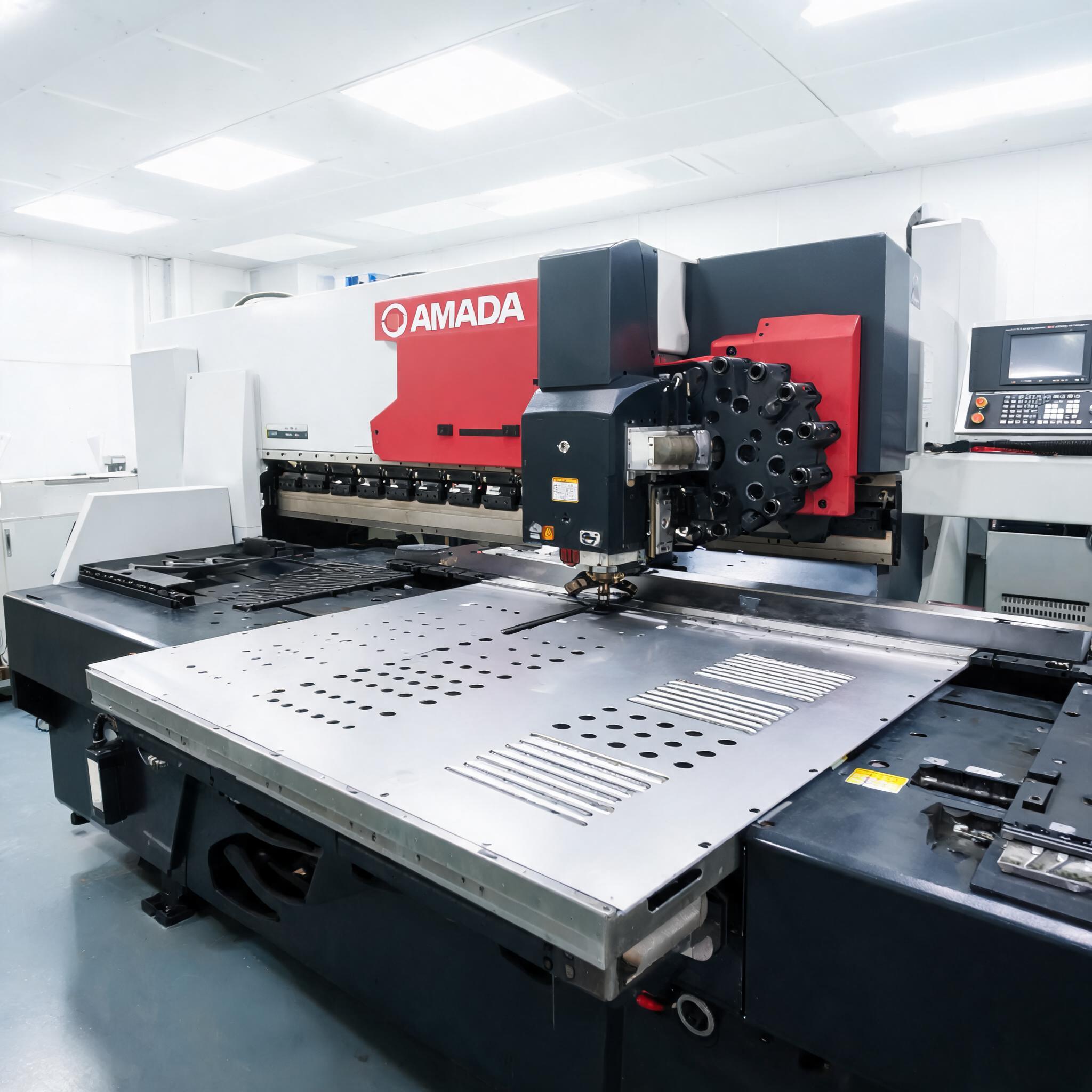
A sheet metal stamping prototype is a quick way to prove formed features like lances, louvers, ribs, and embosses before committing to hard tooling. This article explains what an Amada turret on a TruMatic 6000 can produce in one combined setup, what a sample can and cannot predict about a production die run, and what to record from the sample for the die stage.
Buyers often need a physical part that looks and feels like a stamped component long before a hard die is cut. A sheet metal stamping prototype produced on a turret punch press can prove several formed features in a single setup, giving design and manufacturing teams something concrete to measure, fit, and review. This article covers which formed features a turret can prove on a sample, where a sample’s predictive value ends, and what to record from the sample for the die stage.
Key takeaways
- A TRUMPF TruMatic 6000 laser-and-punch combination machine and an Amada CNC turret press can produce lances, louvers, ribs, and embosses in a single setup on a flat part.
- A turret sample can validate feature geometry, placement, and basic form, but it cannot fully predict die-run behavior such as springback compensation, tool wear, or progressive-die timing.
- Record material lot, feature dimensions, tooling used, and any forming observations so the die design stage starts with data rather than assumptions.
- A first article inspection (FAI) on the sample gives a documented baseline; IATF 16949:2016 processes apply to the production stage, not to the prototype itself.
Why use a turret for a sheet metal stamping prototype?
A turret punch press forms metal by punching and nibbling, and with the right tooling it can also perform a range of forming operations without a dedicated die. The TRUMPF TruMatic 6000 is set up for combined laser cutting and punching, and the Amada CNC turret press carries dedicated forming tools; multiple formed features can be produced while the part stays in one setup. That matters for prototyping because repositioning the part between operations adds stack-up error and time.
For buyers, the practical benefit is speed and flexibility. You get a physical sample that shows the intended form before you commit to a hard tool. If the sample reveals a problem—say, a louver that interferes with a mating part—you can revise the flat pattern and rerun the sample without cutting a die.
Which formed features can a turret prove?
Not every stamped feature is a good candidate for turret forming. The operations below are commonly produced in one combined setup and are well suited to a prototype sample.
Lances
A lance is a partially cut and raised tab, often used as a stop, a contact point, or a locating feature. On a turret, lances are formed with a dedicated lance tool. A sample shows the lance height, the direction of the raise, and how the surrounding material responds. For a buyer, the key check is whether the lance provides the intended function without cracking the base material.
Louvers
Louvers are angled openings used for airflow, heat dissipation, or as a grip surface. Turret louver tools form a series of raised slats. The sample shows the louver angle, the open area, and the edge condition. Because louver forming stretches the material locally, the sample also indicates whether the chosen material and thickness can take the form without tearing.
Ribs
Ribs are narrow raised ridges that add stiffness to a flat panel. A turret can form short ribs with a ribbing tool. On a prototype, ribs are useful for checking the visual profile and confirming that the rib does not interfere with a mating surface. The sample does not replace a structural calculation, but it gives the design team a physical reference for fit and appearance.
Embosses
An emboss is a raised or recessed area, often used for labeling, alignment, or adding local stiffness. Turret embossing tools can produce simple embossed shapes in one setup. The sample shows the emboss depth and the surrounding material draw. For buyers, the important question is whether the emboss is deep enough to be legible or functional without thinning the material to the point of weakness.
What a sample can and cannot predict about a hard-tooled run
A turret sample and a hard-tooled production run are different processes. Understanding the boundary helps you use the sample correctly and avoid overconfidence in the die stage.
| What the sample can show | What the sample cannot predict |
|---|---|
| Feature geometry: lance height, louver angle, rib profile, emboss depth | Springback compensation specific to the die design and press conditions |
| Feature placement and spacing relative to part edges and holes | Tool wear rates and die maintenance intervals in a production run |
| Basic formability of the chosen material and thickness | Progressive-die timing, strip layout, and carrier strength |
| Fit with mating parts when the sample is assembled | Cycle time, tonnage, and press capacity for the production die |
| Visual appearance and surface condition of formed features | Long-run dimensional drift caused by thermal or wear effects |
In short, the sample proves that the feature can exist in the material and that it fits. It does not prove that the same feature will hold tolerance across thousands of strokes in a hard die. Those are separate validation steps.
What to record from the sample for the die stage
Treat the sample as a data source, not just a visual check. Documenting the following items gives the die designer a factual starting point.
- Material lot and thickness: Record the alloy, temper, and actual measured thickness. Forming behavior changes with material condition.
- Feature dimensions: Measure lance height, louver angle and opening, rib height and width, and emboss depth. Note the measurement method.
- Tooling used: Note which turret tools produced each feature. This helps the die designer understand the forming approach that was proven.
- Flat pattern and bend lines: Keep the flat pattern that generated the sample, including bend deductions or K-factor assumptions. This is the starting point for die layout.
- Observations: Record any cracking, thinning, distortion, or springback noticed during forming. These observations flag areas that may need compensation in the die.
- Fit results: If the sample was assembled with mating parts, record whether it fit and where any interference occurred.
A first article inspection (FAI) on the sample provides a formal record of these measurements. FAI documentation can follow the same discipline used in production, even though the prototype itself is not a production part.
How this fits with bending and stamping services
Turret forming handles many features on a flat part, but some prototypes also require bending. Combining turret forming with press brake bending in the same prototype cycle means the sample reflects both the formed features and the bend geometry. For projects that need both, review the capabilities described under Custom Sheet Metal Stamping Services and Custom Sheet Metal Bending Services.
For quality management, note that IATF 16949:2016 applies to the production quality system. A prototype sample is not a production part, but the measurement and documentation practices used on the sample can align with the same system so that data carries forward cleanly.
FAQ
Can a turret sample replace a hard-tooled prototype?
No. A turret sample proves formability, feature geometry, and fit. A hard-tooled prototype proves the die design. They answer different questions and are often used in sequence rather than as substitutes.
How many formed features can be produced in one setup?
That depends on the tooling available in the turret and the part design. The TRUMPF TruMatic 6000 and the Amada CNC turret press both support multiple forming operations in one setup, but the exact mix should be confirmed against the specific part drawing and tool list.
What material should be used for the sample?
Use the material specified for production whenever possible, including alloy and temper. If production material is not available, record the substitute clearly so the die stage knows where the sample may not represent production behavior.
Does an FAI on the sample guarantee the production part will pass?
No. FAI on the sample documents the prototype’s condition. Production part approval is a separate process that accounts for the die, press, and run conditions.