Laser cutting separates parts. It does not bend a louver, raise an emboss, or sink a countersink. This explainer covers the formed features a CNC punch produces in a single hit—louvers, lances, ribs, embossing, countersinks, V-cuts—and when a combined punch/laser setup such as the TRUMPF TruMatic 6000 decides per feature instead of per part.
A laser cutter separates material. It cuts the outline of a bracket, drops a vent slot, trims a blank. What it does not do is form the feature sitting inside that part. If your design calls for a louver, a raised rib, a lanced tab, or a countersink, the laser pass leaves flat steel where the drawing shows a formed shape—and that shape has to come from somewhere else: a punch press, a secondary operation, or a design change.
That gap is where a sheet metal punching service sits. A CNC turret punch does two jobs in the same hit: it cuts the hole, and it forms the feature around or beside that hole. This article explains which features a punch produces in one stroke, where punching beats laser alone, and how a combined machine such as the TRUMPF TruMatic 6000 lets a shop decide feature-by-feature instead of committing the whole part to one process.
What this covers
What a punch forms that a laser cannot
A laser is a thermal cutting tool. A punch is a cold-forming tool as well as a cutting tool. The difference matters for any feature whose third dimension—height, depth, angle—is generated by tooling rather than by removing material.
Louvers
A louver is an opening with the material pushed up into a raised, angled flap, used for ventilation and heat dissipation in enclosures, panels, and cabinets. The punch lances the edge and bends the flap in one stroke. A laser can cut the same opening, but the flap would be a separate formed piece. For a panel with a row of louvers, that is the difference between one tool pass per louver and a stack of extra operations.
Lances and tabs
A lance is a cut that stays attached on one side, folding material up to create a tab, a hook, or a locator. Because the tab remains part of the sheet, it can serve as a mechanical stop or a snap feature without adding hardware. Turret punch tooling produces lances in the cut cycle, so a part with locating tabs does not need a separate bending or welding step for those features.
Ribs and embossing
Ribs and embosses stiffen a flat panel without adding thickness. The punch presses a raised ridge or dome into the sheet. This is a forming operation, and a laser has no way to produce it—there is no cut that leaves a raised rib behind. On parts where stiffness matters but weight and material cost are fixed, forming ribs into an existing panel is a practical alternative to using a thicker sheet.
Countersinks
A countersink is a conical recess around a hole so a flat-head screw seats flush with the surface. A punch forms the cone in the same hit that pierces the hole. If the countersink is left to a drill or a secondary machine, the part moves between setups, and hole-to-cone alignment depends on repositioning. Forming it on the punch keeps the cone concentric with the hole by construction.
The one-hit principle
Every feature above is created by the punch stroke itself. The hole and the form come from the same tool at the same position, so there is no re-registration between cutting and forming. That is the practical meaning of "one hit forms the feature": fewer setups, fewer part moves, and one location reference for both the cut and the shape.
V-cut: separating a part without a laser
V-cut is a punching method for separating material along a line using a V-shaped tool, with scrap suction removing the cut strip as the tool progresses. It is a way to produce a separation cut on a punch press rather than handing the part to a laser. For shops running a turret punch, V-cut extends what the press can finish on its own—so a part whose features are mostly formed can still be separated without a second machine and a second setup. The scrap-suction detail is the practical one on the shop floor: the removed strip is cleared as it is cut, which keeps the work area clean and avoids a manual cleanup pass.
When CNC punching wins over laser alone
The honest answer is that neither process wins everywhere. The choice depends on what the part actually needs. For context, general laser cutting capabilities are described on the Custom Laser Cutting Services page; the comparison below is about which process fits a given feature set.
| Requirement | CNC punching | Laser cutting alone |
|---|---|---|
| Formed features (louver, lance, rib, emboss, countersink) | Produced in the punch stroke | Not produced; needs separate forming or a design change |
| High hole count, repeated patterns | Efficient per hit across a nest | Efficient, but each feature is a cut path |
| Sharp corners and complex contours | Limited by tool geometry | Strong; any contour the program defines |
| Countersink concentric with its hole | Formed and pierced in one location | Would need a secondary drilling/forming step |
| Part separation with formed features present | V-cut plus forming on one machine | Cut only; forming handled elsewhere |
| Setup count for a formed part | One setup, combined tooling | Cut setup plus a separate forming setup |
A useful rule: if the drawing is flat and the only operation is separation, laser is a natural fit. If the drawing carries formed geometry inside the part, punching carries more of the work in one place. When both are true in the same component, the decision is not "punch or laser" for the part—it is per feature.
One setup, two toolsets
The TRUMPF TruMatic 6000 is a combined punch/laser machine: a CNC turret punch and a laser on the same platform. For a part with mixed requirements, the program decides per feature which tool runs. Formed features go to the punch; contours or geometry beyond punch tooling go to the laser. The part is not handed off between machines, so the setup is shared.
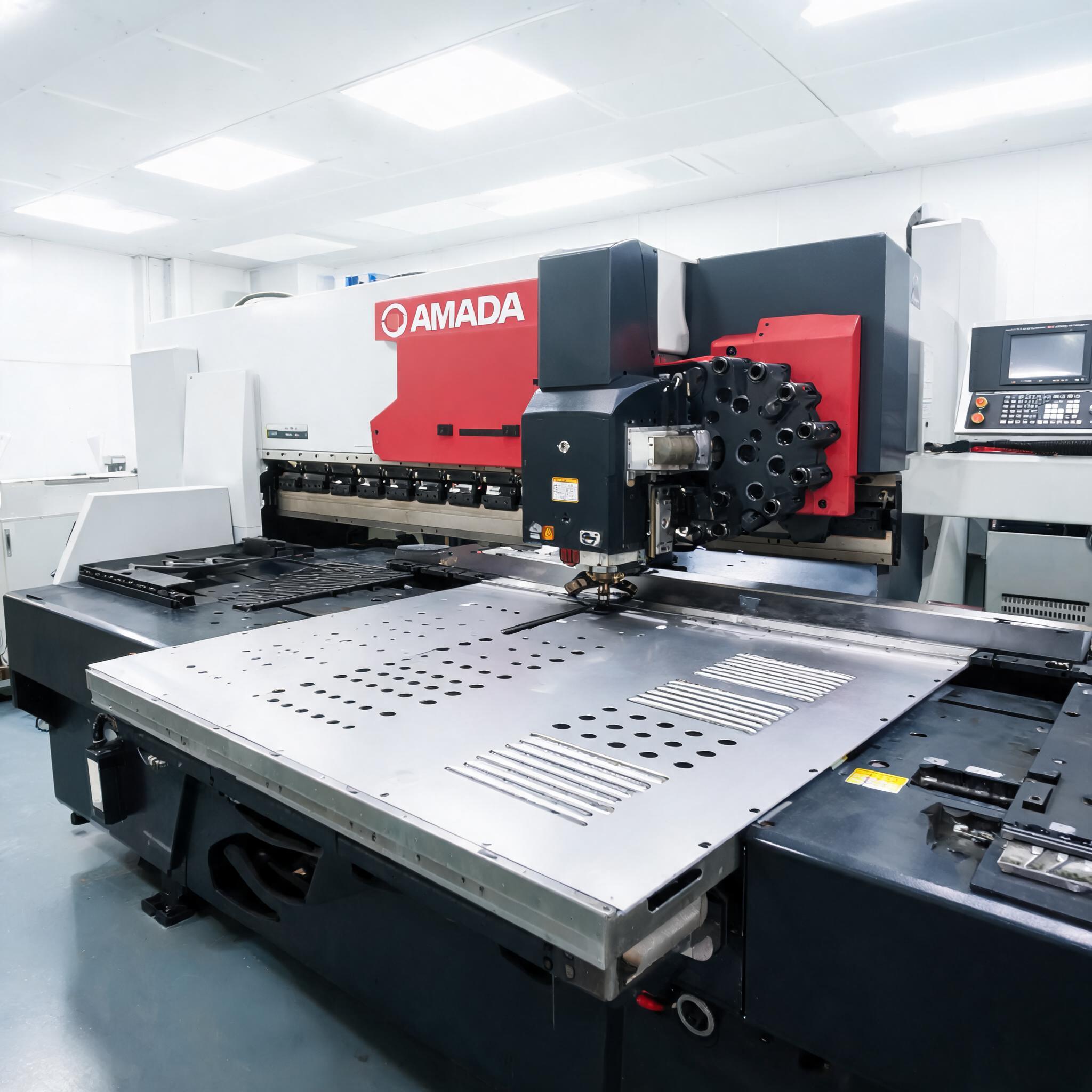
This matters for the buyer because it removes a false choice. On a formed part, the question is not whether the whole job should be punched or lasered; it is which tool makes each feature best, and whether that can happen without breaking setup. Combined machines exist precisely so that answer can be yes on the same part. Shops running Amada CNC turret punches work the same per-feature logic within a punch-only toolset: forming and cutting from the turret, feature by feature.
What to send a punching supplier
Punching is a tooling decision, and tooling depends on the drawing. To get a useful answer rather than a general quote, send the current, released revision of the drawing and the material callout. Relevant materials for formed punching include low-carbon steel, stainless steel, aluminum, and galvanized sheet; the grade and thickness affect which forming tools are used and whether the feature is feasible as drawn.
- Drawing revision: confirm the revision is the one to build, since an outdated file can change which features exist at all.
- Feature list by type: note which features are formed (louvers, lances, ribs, embosses, countersinks) and which are plain cuts.
- Position of formed features: their location relative to the part edge and to holes determines tool access and whether a punch can reach them.
- Material and thickness: forming behavior changes with the material and its gauge.
If quality-system documentation is part of your sourcing requirement, ask the supplier directly for its current certificates and confirm they cover the facility and process you are buying. For reference, our own operations are certified to IATF 16949:2016.
If your project is primarily stamped or formed components rather than cut parts, the Custom Sheet Metal Stamping Services page describes that side of the work. The point is to match the process to the feature, not to a brand preference.
FAQ
Can a laser form a louver or an emboss?
No. A laser removes material along a cut path; it does not raise a flap or press a rib. Louvers, lances, ribs, embosses, and countersinks are formed by punch tooling. A laser can cut the opening, but the formed shape requires a forming operation.
Is punching always cheaper than laser for formed parts?
Not automatically. The cost depends on feature count, tooling availability, and how much secondary work a design would otherwise need. The clearer comparison is setup count: a formed part that a punch can complete in one setup avoids the handoff to a separate forming operation. Per-piece cost depends on the specific drawing, so send it for a real answer.
What is V-cut used for on a punch press?
V-cut separates material along a line using a V-shaped tool, with scrap suction removing the cut strip as it goes. It lets a turret punch finish parts that would otherwise need a laser for separation, which keeps formed-feature parts on one machine and one setup.
What materials can be punched and formed?
Low-carbon steel, stainless steel, aluminum, and galvanized sheet are the common materials for formed punching. The grade and thickness determine which forming tools apply and how the feature behaves, so include both on the drawing when you request a quote.