
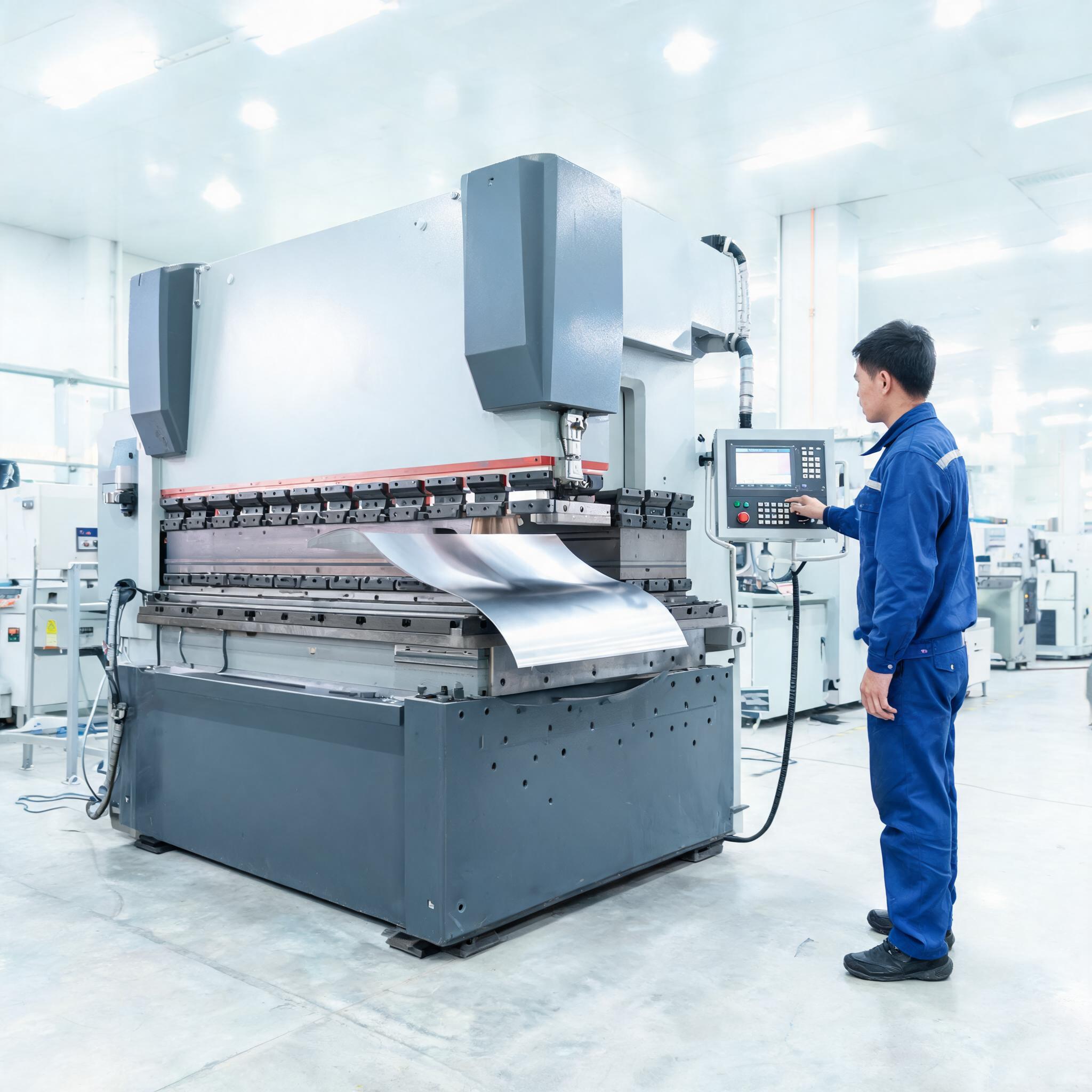
Air bending and bottom bending are the two main press brake methods for a sheet metal bending service. This article compares their trade-offs in angle flexibility, consistency, and tooling, explains which method fits brackets versus enclosures, and lists the information a shop needs to quote and inspect your parts.
Method selection
Two parts can share the same material, thickness, and bend radii and still need different press brake methods. Air bending gives you a range of angles from one tooling setup; bottom bending coins the material into the die and holds a more consistent angle across a batch. The choice affects what you can change after the first article, how repeatable the angles are, and how the shop plans the bend sequence. This article covers the trade-offs and what to specify for brackets versus enclosures.
Key takeaways
- Air bending uses the punch to push the sheet into the die without bottoming out, so one tool set can produce a range of angles and usually needs less tonnage per bend.
- Bottom bending forces the sheet to the die bottom, which helps hold angle repeatability across a run but limits angle changes without changing setup.
- For brackets, angle flexibility and quick drawing revisions often favor air bending. For enclosures, appearance and consistent gaps may favor bottom bending.
- Typical sheet thickness for these methods is 0.5–6 mm; typical air-bend angle tolerance is around ±0.5°, depending on material, tooling, and part size.
How the two methods differ
Both methods run on a press brake. The difference is how far the punch travels.
Air bending puts the sheet across the die shoulders and pushes the punch down only far enough to form the target angle, without the sheet touching the die bottom. The formed angle depends on the punch depth, the die opening, the material, and the springback. Because depth controls the angle, the same tooling can produce different angles by changing the program. That is why air bending is the default for many custom parts.
Bottom bending presses the sheet until it contacts the die bottom. The material is forced into the die angle, and the punch stays at the bottom. The die angle sets the target angle, and springback is compensated by the die geometry rather than by depth alone. The result is a more consistent angle from part to part when the material and thickness are stable.
Springback compensation is the reason both methods need attention. Low-carbon steel springs back less than stainless steel, and aluminum varies with temper. Air bending compensates in the program by over-bending slightly. Bottom bending compensates through die angle and tonnage. In both cases, the first article tells the operator whether the compensation is right.
Trade-offs at a glance
| Factor | Air bending | Bottom bending |
|---|---|---|
| Angle flexibility | Wide range from one setup; change angle in the program | Limited to die angle; change angle needs different tooling |
| Angle consistency | Depends on depth control, material, and springback | More consistent across a batch when material is stable |
| Typical angle tolerance | Around ±0.5° (typical) | Around ±0.5° or tighter (typical, setup dependent) |
| Typical thickness range | 0.5–6 mm (typical) | 0.5–6 mm (typical) |
| Tooling | Standard punch and die; fewer changes | Die matched to angle; more setup per angle |
| Best fit | Brackets, prototypes, mixed angles, drawing revisions | Enclosures, repeated angles, visible gaps |
Values are typical for low-carbon steel, stainless steel, and aluminum on a press brake. Actual tolerance depends on material, thickness, tooling, and part size.
Brackets: flexibility usually wins
Brackets tend to have several bends at different angles, often in low to medium quantities. Air bending lets the shop run those angles from one tooling setup, so a drawing revision that changes one angle does not require a new die. That flexibility matters when the part is still being finalized or when the order mixes several bracket variants.
If a bracket has one dominant angle and high annual volume, bottom bending can make sense because the angle repeatability is easier to hold. But many bracket programs are better served by air bending plus a first article inspection.
Enclosures: consistency and appearance
Enclosures are judged by how they look and fit. Door gaps, corner alignment, and panel flatness are visible, and a small angle variation that is invisible on a bracket can show up as an uneven gap. Bottom bending helps here because the die controls the angle and the batch holds it more tightly.
Enclosures also often use the same angle many times, so the extra setup for a matched die is paid back over the run. If the enclosure has several different angles, the shop may use air bending for the less visible bends and bottom bending for the visible ones. That mix is common and is worth discussing before quoting.
Material and springback
Low-carbon steel is the least demanding: it forms predictably and springback is modest. Stainless steel work-hardens and springs back more, so air bending needs more over-bend and bottom bending may need higher tonnage. Aluminum depends on temper; soft tempers form easily but can mark, while harder tempers behave closer to stainless.
For any of these, the shop should tell you which method it plans to use and how it will handle springback. That is a normal part of quoting, not a trade secret.
Bend sequence planning
Bend sequence is set before the first part is formed. The order of bends determines whether the part can be held in the tooling without colliding with already-formed flanges. Air bending gives the planner more freedom because the punch depth can be adjusted, but sequence still matters. Bottom bending is less forgiving because the die fixes the angle, so a later bend cannot correct an earlier one as easily.
A shop with good process control will plan the sequence in the CAM or offline program and confirm it on the first article. If your part has tight flanges or deep U-shapes, ask how the sequence was checked before production.
First article inspection and quality systems
Whichever method is used, the first article is the point where the method, tooling, and program are confirmed. The shop should measure the angles and key dimensions, record the results, and only then release the run. For automotive or similar work, an IATF 16949:2016 quality system gives a documented framework for that first article and for ongoing inspection. If your program requires it, confirm the supplier's certification scope covers the bending process, not just the company name.
What to give the shop
To quote and produce accurately, the shop needs:
- 2D drawing or 3D model with bend angles, radii, and tolerances.
- Material grade, temper, and thickness.
- Method preference, if you have one, and the reason (appearance, volume, or revision risk).
- Quantity and whether it is a one-off, prototype, or production run.
- Critical dimensions and which angles matter most.
- Surface finish requirements, because tooling marks show differently on air-bent and bottom-bent parts.
- Any inspection or documentation requirements, including first article reports.
If you are unsure which method fits, describe the function of the part: a bracket that must fit an assembly is different from a cover that must look even. That tells the shop more than a method name.
Related services
Our Custom Sheet Metal Bending Services cover press brake air bending and bottom bending for low-carbon steel, stainless steel, and aluminum. For parts with tighter angle or finish requirements, see precision bending (extended specs).
FAQ
Can one part use both air bending and bottom bending?
Yes. It is common for an enclosure to use bottom bending for visible bends and air bending for internal bends where the angle is less critical. The shop decides based on the drawing and the function of each bend.
Which method gives a better angle tolerance?
Bottom bending is generally easier to hold consistently across a batch because the die sets the angle. Air bending can also reach around ±0.5° typical tolerance, but it depends more on material consistency, depth control, and springback compensation.
Does the method change the price?
It can. Air bending usually needs less tooling and fewer setups, which helps on mixed-angle or low-volume parts. Bottom bending may need a matched die and more setup, which is usually justified by higher volume or visible appearance requirements. Ask the shop to quote the method it plans to use.
What if my drawing does not specify a method?
The shop will choose based on material, thickness, quantity, and function. If angle consistency or appearance is critical, say so on the drawing or in the RFQ so the method is not left to chance.
Next step
Send the drawing, material, thickness, quantity, and the function of the part. If you have a preferred method, say why; if not, describe what the part has to do and the shop can recommend one. First article inspection results should be shared before the full run so any adjustment is made while it is still cheap.