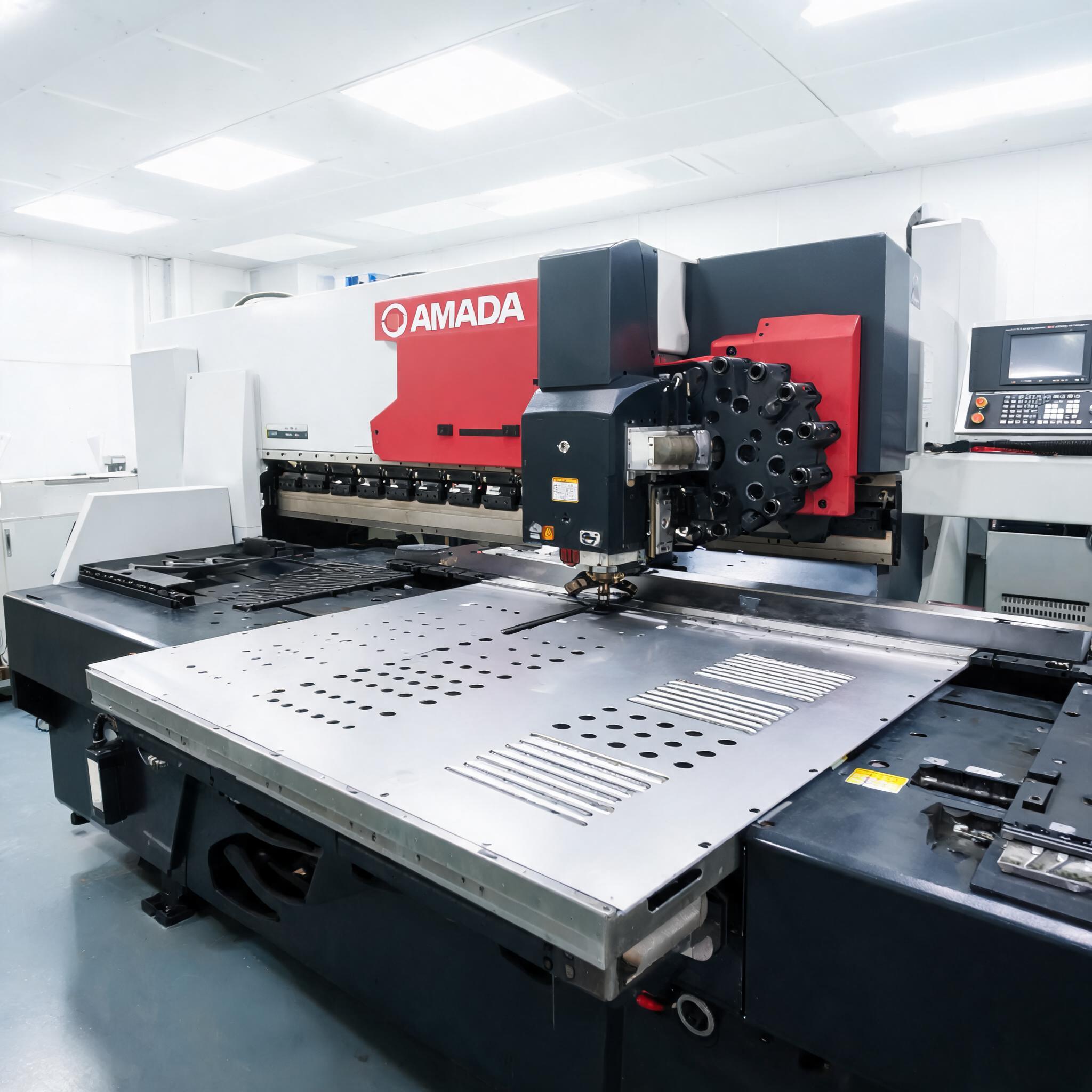
Turret punching forms louvers, lances, ribs, embossed features, countersinks and V-cuts in a single setup, often without a dedicated forming die. This article explains which features a CNC turret can produce, when it replaces hard tooling, when hard tooling still wins, and how a TRUMPF TruMatic 6000 combines laser cutting and punching per feature.
Process capability
A CNC turret punch does more than cut holes. It can raise louvers, bend lances, stiffen a panel with ribs, emboss a logo, sink a countersink for a flush fastener and make a V-cut for a bend line - all while the sheet stays in one setup. This article covers which formed features belong on a turret, when custom sheet metal stamping on a turret is the right call instead of paying for a forming die, and where hard tooling still makes more sense.
Key takeaways
- A turret punch forms louvers, lances, ribs, embossed features, countersinks and V-cuts in the same setup as the cut profile, so formed features do not require a dedicated forming die.
- It suits low and mid volume runs, design iterations and parts that mix many features in one program.
- Hard tooling still wins when a single feature repeats in very high volume and the geometry is stable.
- A TRUMPF TruMatic 6000 combines laser cutting and punching, so a part can be cut and formed feature by feature in one pass.
- Low-carbon steel, stainless steel, aluminium and galvanized sheet are the usual materials, held under an IATF 16949:2016 quality system.
On this page
- What a turret actually forms
- The forming features in detail
- When turret forming replaces hard tooling
- When hard tooling still wins
- Combining laser and punch in one setup
- Materials and quality system
- FAQ
What a turret actually forms
A turret punch holds a set of tools in a rotating station. Most of those tools cut - round holes, slots, rectangles, profiles - but a subset of them are forming tools. Instead of removing metal, they deform it: they push a small tongue of material outward, raise a lip, press a rib, or press a partial shape into the sheet surface.
The practical consequence is that formed features stop being a separate operation. On a punched part, the louver that lets air through a panel and the hole next to it come off the same machine, positioned by the same program, in the same setup. There is no second handling step, no separate press, and no dedicated forming die to design, order and store.
The forming features in detail
Louvers
A louver tool raises a slanted opening in the sheet. Louvers are used on ventilation panels, enclosures and covers where air must pass but the opening should not be a plain hole. Because the louver is placed by the punch program, its position and orientation stay consistent across a batch and can be moved easily when the panel layout changes.
Lances
A lance is a tab or tongue of material partially cut and bent out of the sheet. It can act as a locating tab, a stop, a small hook, or a contact point in an assembly. Lance geometry is defined by the tool, so a lancet feature that appears in several places on a part is simply repeated in the program.
Ribs
Ribs are pressed ridges that stiffen a flat panel. A long unsupported cover or bracket can flex under load; one or more ribs raise its stiffness without adding a separate part or extra material thickness. Rib direction and spacing are set in the punching program and can be adjusted between revisions.
Embossing
An emboss tool presses a raised or recessed mark into the surface - useful for a logo, a part number, a polarity mark, or an orientation cue that must survive painting or coating. The mark is formed, not printed, so it does not depend on ink adhesion.
Countersinks
A countersink tool forms the conical seat that lets a flat-head screw sit flush with the sheet. Where a part needs several flush fasteners, each countersink is placed by the program and formed while the sheet is still in position.
V-cut
A V-cut scores a narrow groove along what will become a bend line, so the following bend lands in a controlled place and needs less force. Chips from the cut can be cleared with scrap suction, which keeps the sheet surface clean for downstream handling.
| Feature | What it does | Typical use |
|---|---|---|
| Louver | Raises a slanted opening in the sheet | Vent and airflow panels, enclosures, covers |
| Lance | Partial cut-and-bent tab of material | Locating tabs, stops, small hooks, contacts |
| Rib | Pressed ridge that stiffens a flat panel | Brackets, covers, long unsupported panels |
| Emboss | Raised or recessed mark in the surface | Logos, part numbers, orientation marks |
| Countersink | Conical seat for a flat-head fastener | Flush screw joints on panels and plates |
| V-cut | Scores the bend line, with scrap suction clearing chips | Controlled bend location on the press brake |
When turret forming replaces hard tooling
The decision is mostly about volume and change. A dedicated forming die makes sense when the same feature repeats in a very large number of identical parts, because the die cost is spread across that volume. Turret forming makes sense when that assumption does not hold.
- Low and mid volumes. When a part is needed in the hundreds or low thousands rather than in die-level volumes, there is no tooling cost to recover, so the turret program is the cheaper route.
- Design that is still moving. If the louver count, rib position or countersink layout may change between revisions, the program changes with it. A hard die would have to be recut.
- Many different features on one part. A panel with a louver group, two ribs, a countersink pattern and an embossed part number is a single turret program. On a press line it would be several stations and several setups.
- Prototypes and pre-production. A turret gives a formed sample without committing to a forming die, so a design can be checked in the hand before tooling money is spent.
- Mixed orders. When one order contains several part numbers, each in modest quantity, running them on the turret avoids a tooling investment per part.
For parts that also need tight cut geometry alongside the formed features, pairing the turret with Custom Laser Cutting Services covers profiles the punch tooling cannot produce cleanly.
When hard tooling still wins
Hard tooling is not obsolete, and no single feature decides it. The pattern is repetition at scale.
- Very high annual volume of a stable part. When a feature repeats across large, predictable volumes, the per-part cost of a progressive or forming die eventually beats the per-part machine time of punching.
- Deep or complex forms. Some geometries need more forming force or a more controlled material flow than a turret tool can provide in one hit.
- Thick material. Heavier gauges demand forming energy that a turret forming tool is not built for.
- Features that must be identical for years. If the geometry is frozen and the volume is there, tooling gives repeatability with less per-part machine time.
In practice many projects run turret first and move to hard tooling only after the design is frozen and volume has grown. That sequence avoids paying for a die before the part is settled. Our Custom Sheet Metal Stamping Services cover both routes.
Combining laser and punch in one setup
The reason formed features and cut geometry fit together so well is that machines such as the TRUMPF TruMatic 6000 combine laser cutting and punching in one unit, alongside our Amada CNC turret punch. The machine decides per feature which process to use: the punch for formed features and for standard cut shapes where it is faster, the laser for contours, tight radii and shapes that no punch tool covers.
Because both processes run in one setup, a part does not move between machines between cutting and forming. That removes a handling step and the re-clamping error that comes with it. A louver, the holes around it, and the outer profile can all be produced with the sheet referenced to the same origin.
That combination is what makes toolless forming practical on parts that also need complex cut outlines. For V-cut bends, the scrap suction keeps the cut line clear, which matters when the sheet goes straight from the punch to the press brake.
Materials and quality system
The usual workpiece materials are low-carbon steel, stainless steel, aluminium and galvanized sheet. Formability differs between them - stainless work-hardens and needs different tool settings from low-carbon steel, and galvanized sheet calls for care at the formed edge to avoid coating damage - so the material belongs in the discussion before the tooling is set.
Formed parts are produced under an IATF 16949:2016 quality system. That system applies to the process and the parts it covers; it is not a statement that every part or every material combination is certified for a given end use. If your programme requires specific documentation, ask for it against your part number.
Frequently asked questions
Can a turret punch form features without a forming die?
Yes. Louver, lance, rib, emboss, countersink and V-cut tools sit in the turret station and form the sheet in the same setup as the cut profile. This is what makes custom sheet metal stamping on a turret viable at low and mid volumes, where a dedicated forming die would not be justified.
What is the volume break-even between turret forming and hard tooling?
There is no fixed number, because it depends on part size, feature count, material, cycle time and how stable the design is. A forming die carries its cost upfront and recovers it across the run; a turret spreads cost across machine time. The right comparison is your own annual quantity and expected design lifetime against both quotes.
Can laser cutting and punch forming be done in one operation?
On a combined machine such as the TRUMPF TruMatic 6000, yes. The machine chooses per feature whether to punch or laser cut, so cut contours and formed features come off the same setup without the sheet being moved between machines.
Which materials can be formed on a turret?
Low-carbon steel, stainless steel, aluminium and galvanized sheet are the usual materials. Because each behaves differently under forming - stainless work-hardens, galvanized sheet needs care at the formed edge - send the material grade and thickness with your drawing so the tooling and settings can be confirmed before production.
Next step
If your part needs louvers, lances, ribs, embossing, countersinks or V-cut bend lines and you would rather not pay for a forming die yet, the fastest way to get a firm answer is to send the drawing with the material grade, thickness, quantity and any known revision plans. From that we can confirm which features run on the turret, whether a combined laser and punch setup is needed, and whether the volume makes hard tooling worth discussing. Our team has been producing custom sheet metal work since 2009.