
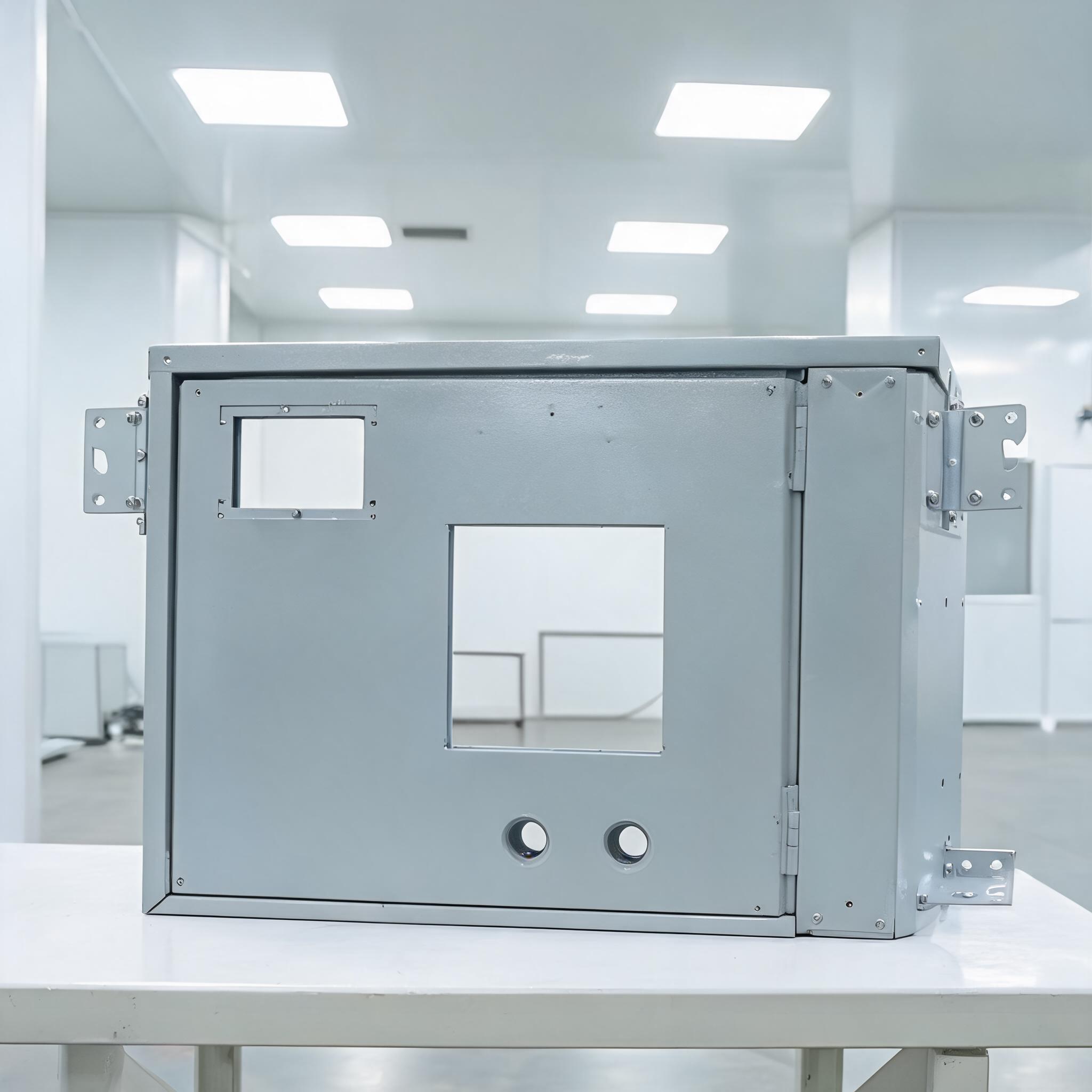
A construction guide for buyers sourcing custom sheet metal boxes and housings. It compares welded, tabbed, and riveted corner joints, explains hemmed edges and lid fits, and shows how each choice affects tooling, appearance, and unit cost.
Construction Guide
Two suppliers can quote the same custom sheet metal boxes from the same drawing and still ship parts that feel completely different. The difference is usually not the material or the coating. It is the corner joint, the edge treatment, the lid fit, and how the hardware is attached. Those four decisions drive stiffness, safety in handling, appearance, and a large share of unit cost.
This guide walks through each choice from a buyer's point of view: what the option does, what it costs, and what to specify on the drawing.
Key takeaways
- Welded corners give the stiffest, most sealed box; interlocking tabs and spot welds reduce cost where sealing is not required.
- Hemmed edges fold the raw sheet back on itself, removing the sharp burr and adding stiffness without extra material.
- Lid and door fit is set by the clearance allowance in the drawing, not by the coating.
- Hardware integration should be decided before press brake programming, because hole positions determine the bend sequence.
On this page
Corner joints: welded, tabbed, or riveted
A box has four vertical corners and, usually, four top and bottom fold lines. How those corners are closed determines how much the box resists twisting and how clean it looks from the outside.
Welded corners
The sheet is bent to overlap at the corner and then joined by MIG, TIG, spot, or laser welding. MIG is fast and suits thicker gauges and long runs. TIG gives finer control and a smoother bead that is easier to dress for a visible stainless finish. Spot welding is used where overlap position allows it and appearance is not critical. Laser welding produces a narrow, low-distortion seam that needs little or no post-grinding.
After welding, corners are usually ground flush. On a powder-coated box, weld dressing determines whether the corner reads as a continuous surface or as a visible joint. Welded corners are the right choice when the box must resist vibration, hold internal components in alignment, or meet an enclosure sealing requirement.
Interlocking tabs
Sheet is bent with tabs that engage matching slots in the adjacent flange, then locked by spot welds or a folded seam. Tab-and-slot construction self-locates, so assembly is faster and less dependent on a welder's skill. It is common on lighter-gauge boxes, brackets, and cover panels where the load is modest.
The trade-off is sealing and stiffness. A tabbed corner is not a continuous joint, and powder coating may not bridge the remaining gap. If the box needs to keep out dust or liquid, confirm with the supplier whether the joint is acceptable for the target protection level before the design is frozen.
Riveted and clinched corners
Rivets or clinch joints avoid heat and distortion, which matters when the box is assembled after coating or when the sheet is too thin to weld without warping. They are visible from the outside, so they suit industrial or maintenance-friendly designs better than consumer-facing product housings.
Seams and edge finishing
Every cut sheet has a burr. Left in place, it cuts gloves, snags wiring harnesses, and looks unfinished. Two edge treatments dominate custom sheet metal boxes.
Hemming and edge folding
A hem folds the edge of the sheet back on itself, usually 180 degrees, trapping the raw burr inside the fold. The result is a rounded, safe edge and, because the fold adds a second layer of material along the edge, noticeably more stiffness in that direction. Hemming is done in the press brake after bending, using a hemming die.
- Close hem: the folded edge is flattened tight against the sheet. Cleanest appearance, needs a controlled bend allowance.
- Open hem: a gap is left inside the fold, useful when the edge must accept a panel or gasket.
- Safety hem: a partial fold that removes the sharp edge without a full 180-degree turn.
Hemming is not free. It adds a press brake operation and narrows the tolerance window on the blank size. On small boxes with many short edges, the tooling access can also limit how close the hem can run to a corner.
Deburring and edge grinding
Where hemming is not practical, edges can be deburred or lightly ground. This removes the sharpness but adds no stiffness, and it leaves a slightly different surface texture along the edge. On powder-coated parts the coating covers the texture, but on brushed stainless the difference can remain visible.
Lid, door, and closure fit
Lid fit is the first thing a buyer sees and the first thing a user feels. It is determined by the clearance built into the drawing, not by the coating thickness.
Removable lid
A lid with a small clearance gap lifts off easily and tolerates coating buildup. A tight, near-zero gap looks better but can bind after powder coating if the internal faces are also coated. If the lid must slide or lift freely, state the expected gap and ask the supplier to confirm it after coating.
Hinged door
Hinged doors add a knuckle or piano hinge, a latch, and often a stop. Each of these is a separate hardware item with its own position tolerance. Because a door swings, the fit must be checked through the full arc, not just in the closed position.
Closure methods
- Screws and captive fasteners: simple, serviceable, and easy to specify; add assembly time and a visible fastener line.
- Quarter-turn latches and cam locks: tool-free access, common on electrical and control enclosures.
- Gasket-sealed covers: require a consistent flange flatness and a controlled screw torque pattern; the corner joint must also be sealed to make the gasket effective.
If the enclosure is intended for an application covered by a quality management system such as IATF 16949:2016, confirm with the supplier which of their processes and sites are actually in scope. A certificate held by one facility does not automatically apply to every product line.
Hardware integration
Hardware should be decided before the bend program is finalized, because hole and insert positions determine the order in which the box is formed.
- PEM-type inserts and standoffs: pressed into the flat sheet before bending. Pressing after forming is difficult where the flange blocks the press.
- Threaded rivet nuts: installed after forming, useful for retrofit or for positions that cannot be pressed.
- Mounting bosses and brackets: bent into the box itself, saving a separate part but constraining the blank layout.
- Cable glands and connectors: require a clean, flat area and enough internal clearance behind the panel.
A practical sequence is: flat pattern and insert pressing, press brake bending, corner joining, hardware installation, deburring, then finishing. Deviating from this sequence usually adds a second handling step and cost.
How construction choices affect cost and appearance
The table below summarizes the trade-offs. It is a comparison of construction options, not a ranking; the right choice depends on the load, the environment, and the appearance target.
| Feature | Typical construction | Cost impact | Appearance |
|---|---|---|---|
| Corner joint | MIG or TIG welded, ground flush | Highest labor; grinding adds a step | Continuous surface; weld may still show through thin coatings |
| Corner joint | Interlocking tabs with spot welds | Lower labor; fast self-locating assembly | Visible joint line; not a sealed corner |
| Corner joint | Riveted or clinched | Low heat, no distortion; visible fasteners | Industrial look; suited to serviceable designs |
| Edge treatment | Close hem | Extra press brake operation | Rounded, clean edge; hides the burr |
| Edge treatment | Deburr only | Lowest | Sharp edge removed; texture can vary |
| Lid fit | Tight clearance | Higher tolerance control | Flush appearance; risk of binding after coating |
| Lid fit | Open clearance | Lower | Visible gap; tolerant of coating build-up |
| Hardware | Pre-bend inserts | Efficient at volume | Flush internal mounting |
| Hardware | Post-form rivet nuts | Flexible for low volume | Visible from inside |
Two points are easy to overlook. First, powder coating adds thickness on every coated surface, so a lid that fit before coating may not fit after it. Second, the bend radius and the material gauge limit how tight a corner can be formed, which in turn limits how small the finished box can be. Both should be discussed with the fabricator during quoting, not after the first article is made.
For buyers who need a finished housing rather than loose parts, the full scope from flat pattern to coated assembly is covered under Custom Sheet Metal Enclosure Fabrication. Where the requirement is limited to forming and bending, the capability sits under Custom Sheet Metal Bending Services.
FAQ
Should I specify a welded corner or an interlocking tab for a small box?
Choose a welded corner when the box must be stiff, sealed, or vibration-resistant. Choose interlocking tabs with spot welds when the load is light and the joint line is acceptable. The deciding question is whether the box must keep out dust or liquid; if it must, a tabbed corner may not be sufficient without additional sealing.
Does hemming add much to the price?
Hemming adds one press brake operation per hemmed edge and tightens the blank tolerance. For a box with several short hemmed edges, that labor can be a noticeable share of the piece price. Confirm the per-edge cost with the supplier before assuming hemming is cheap.
Why does my lid fit change after powder coating?
Powder coating builds a film on every coated surface, including the mating faces of the lid and the opening. A clearance that was adequate on bare metal can close up after coating. Specify the clearance for the coated condition, or mask the mating faces.
Can hardware be installed after the box is formed and coated?
Rivet nuts and some threaded fasteners can be installed after forming, and post-coating installation avoids coating damage around the hole. Pressed inserts generally need flat access and are installed before bending. Decide the sequence with the fabricator at quoting stage.
The construction details above are the ones that decide how a sheet metal box performs in service and how it looks on the shelf. A drawing that names the corner joint, the edge treatment, the lid clearance, and the hardware sequence removes most of the guesswork between quote and first article.
To review these choices against a specific design, share the drawing, target gauge, finish, and expected annual volume with the fabrication team through Custom Sheet Metal Enclosure Fabrication.