A finish-selection guide for buyers comparing powder coating, anodizing, and bare metal. It maps four environments—indoor steel enclosures, outdoor installations, aluminum precision parts, and washdown stainless—to the finish each one actually requires, and explains what each process changes in corrosion resistance, appearance, dimensions, and masking.
Finish Selection Guide
Bare cold-rolled steel starts to rust before it reaches the assembly line if it sits in a humid plant. That is one reason the choice between powder coating, anodizing, and bare metal is not a style decision. The finish has to match where the part will live, what it will touch, and what tolerances it must hold after coating. The four buying scenarios below cover most sheet metal finish requests: indoor steel enclosures, outdoor installations, aluminum precision parts, and washdown stainless.
What this guide covers
- What each finish changes: corrosion, appearance, dimensions, masking
- Powder coating for indoor steel and outdoor housings
- Anodizing for aluminum precision parts
- When bare or passivated stainless is the right answer
- Pre-treatment, masking, and quality management notes
What Each Finish Actually Changes
Before comparing environments, it helps to see what each option changes on the part itself. Buyers often focus on appearance and corrosion, then discover the finish also affects thread fit, ground continuity, and dimensional stack-up.
| Finish | Corrosion resistance | Appearance | Dimensional effect | Typical masking needs |
|---|---|---|---|---|
| Bare metal | None on carbon steel; stainless depends on grade and environment | Mill finish, may show scratches and handling marks | None | None |
| Powder coating | Protective barrier on steel; performance depends on pre-treatment and film build | RAL colors or customer sample; matte, satin, or gloss textures | Adds film thickness per drawing; can affect tight fits | Threads, contacts, ground points, mating surfaces |
| Anodizing Type II | Oxide layer on aluminum; better than bare aluminum in most indoor and moderate outdoor use | Natural, black, or dyed colors | Build-up is thin compared with powder; still specify per drawing | Electrical contacts, threaded holes when called out, sealing surfaces |
| Anodizing Type III (hard coat) | Thicker oxide layer; used where wear resistance matters as much as corrosion | Typically darker, less color range than Type II | Thicker build than Type II; confirm on drawing | Same masking categories; dimensions need closer review |
Deburring sits before all of these. Sharp edges and burrs interfere with coating adhesion and anodize coverage, and they are a handling hazard during assembly. For parts that will be coated or anodized, deburring is normally treated as pre-treatment rather than a separate cosmetic step. See Custom Sheet Metal Deburring Services for how that stage is handled.
Indoor Steel Enclosures: Powder Coating Is Usually the Default
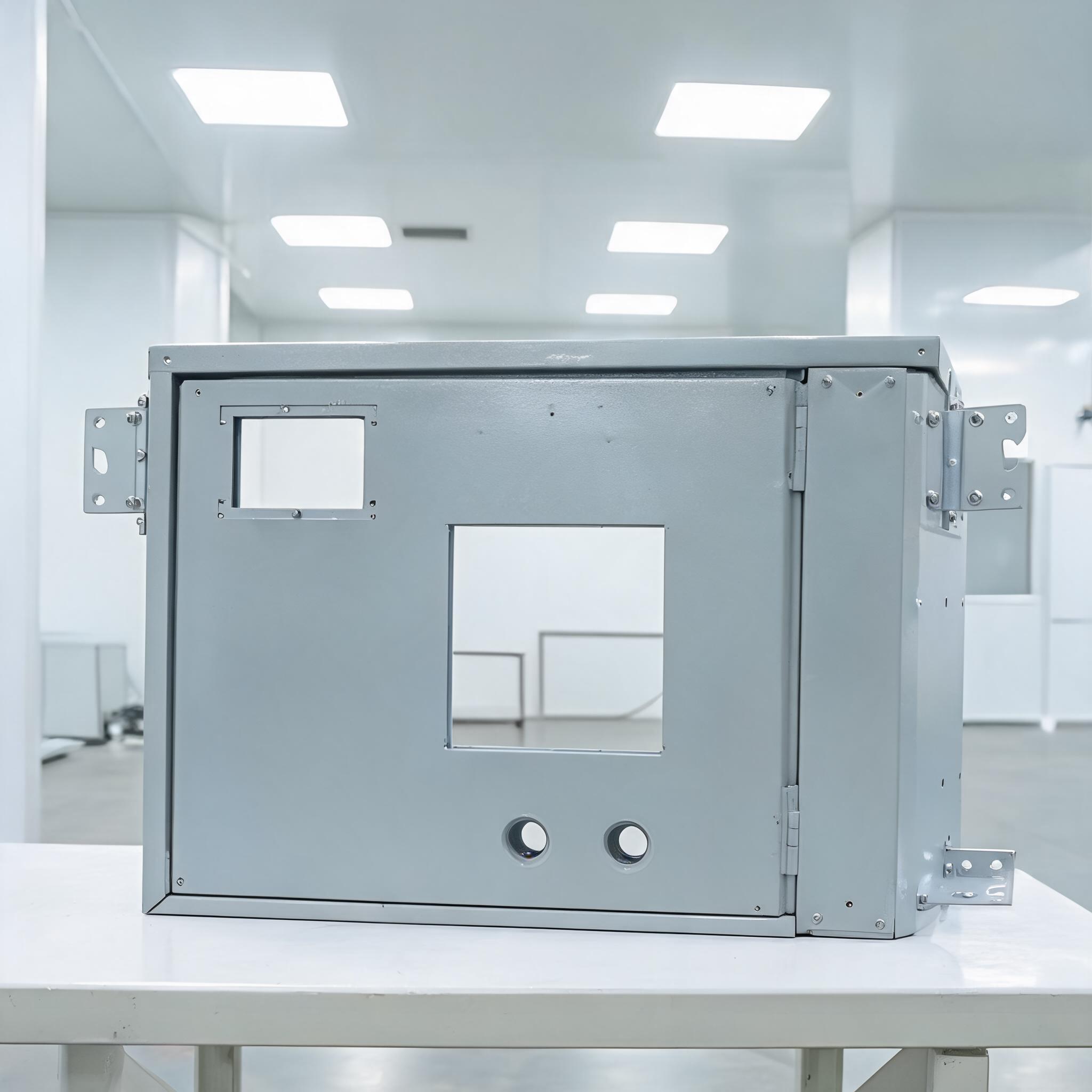
An indoor enclosure—control cabinet, equipment housing, rack panel—faces dust, occasional moisture, and handling rather than direct weather. The typical requirement is a uniform, repairable-looking finish in a specified color, at a film thickness that does not interfere with door alignment, hinges, or gasket seats.
Powder coating applies electrostatically and cures thermally. Charged powder particles deposit on the grounded part, and the coating flows and crosslinks in an oven. Two practical consequences for buyers:
- Color control. Powder is ordered to an RAL number or matched to a customer sample. If the sample is the reference, keep a physical standard on file, because color judgments drift across screens and lighting.
- Film thickness. Thickness is specified per drawing. A minimum and maximum range is normal; a nominal value with no tolerance is not enough for a coater to work to.
Masking on indoor enclosures
Threaded inserts, grounding studs, contact areas, and sometimes hinge bores are masked before coating. If masking is not defined on the drawing, the coater has to guess, and a coated grounding point or a threaded hole with film build becomes a rework item. Specify masking per drawing rather than leaving it to the shop floor.
Custom color matching and masking schedules are covered under Custom Powder Coating Services.
Outdoor Installations: Finish Selection Does More Work
Outdoor enclosures, brackets, and mounting hardware face UV, rain, temperature cycling, and in coastal or industrial areas, salt and chemical exposure. The finish is no longer mostly about appearance.
For steel outdoors, powder coating remains common, but the pre-treatment underneath the powder matters as much as the powder itself. A phosphate or equivalent conversion step before coating is what gives the film something to bond to; skipping it is a common cause of early blistering and edge rust. Buyers evaluating a supplier for outdoor parts should ask what pre-treatment line is used, not only which powder brand.
Two further points for outdoor work:
- Edges and cut faces. Coating coverage on sheared edges is thinner than on flat faces. Designs that expect a coated edge to survive years of weather should be discussed with the fabricator.
- Fastener compatibility. If the enclosure will use stainless hardware against a coated steel body, specify it. Mixed hardware can create galvanic couples that the coating cannot control.
Aluminum used outdoors can also be anodized, particularly where the part is visible and the customer wants a metal appearance rather than a painted one. Dyed black anodized aluminum is a frequent choice for architectural and instrument hardware.
Aluminum Precision Parts: Type II or Type III Anodizing
Aluminum machined or formed parts usually go to anodizing rather than powder coating for two reasons: the oxide layer is integral to the metal rather than a separate film, and the build-up is small enough for tighter tolerances.
Type II sulfuric anodizing
Type II is the general-purpose anodize. It produces a clear or dyed finish in natural, black, or other colors. It is the usual choice for enclosures, panels, brackets, and consumer-facing hardware where the requirement is a consistent, corrosion-resistant surface with a metallic look.
Type III hard coat
Type III, or hard coat, produces a thicker oxide layer used where abrasion and wear resistance matter—sliding surfaces, wear plates, parts that see frequent contact. The thicker build deserves attention during drawing review: a feature that fits at bare aluminum may not fit after hard coat if the tolerance was set tight.
Masking and dimensional notes for anodizing
- Electrical contacts, grounding points, and some threaded holes are masked per drawing. Anodize is an insulator, so a masked contact area is sometimes required for electrical continuity.
- Color varies with alloy and with the anodize batch. Black on 6061 and black on 5052 will not be identical. Where color must match across multiple parts, say so at the quote stage.
- Confirm whether the drawing calls out Type II or Type III, and the required thickness range. This is one of the most common omissions on anodizing drawings.
Color and masking options are described under Custom Aluminum Anodizing Services.
Washdown Stainless: Sometimes the Answer Is No Coating
Food equipment, pharmaceutical housings, and some laboratory enclosures are washed down regularly, often with alkaline or acidic cleaners. For these parts, the material is usually stainless steel, and the finish question becomes different: whether to coat at all.
Coating a washdown stainless part is usually unnecessary and can be counterproductive. A coated surface can chip at edges, and a chipped area on a stainless panel creates a crevice where moisture and cleaning chemicals collect. In most washdown applications, the practical finish is the stainless surface itself, with attention to:
- Passivation after fabrication to remove free iron and restore the passive oxide layer, particularly after machining or welding.
- Surface preparation and consistent grain or brushed direction if appearance matters.
- Deburring and weld dressing so there are no crevices or sharp edges that trap residue.
Where color coding is required for washdown equipment, discuss it with the fabricator before assuming a coating will hold up; in some cases, colored components are specified in a different material rather than coated.
Pre-Treatment, Masking, and Quality Management
Finish quality is largely determined before the part reaches the coating or anodizing line. Deburring, cleaning, and pre-treatment control adhesion. Masking control determines whether the part functions after finishing. For automotive and many industrial programs, IATF 16949:2016 is the quality management framework buyers ask about; whether it applies to a specific part should be confirmed with the supplier rather than assumed from a general statement.
What to put on the drawing. Finish type and specification, color reference (RAL number or physical sample), film thickness or coating class with tolerance, masking locations, and any surfaces that must remain conductive. A drawing that names only the color leaves the rest to interpretation.
Frequently Asked Questions
Can powder coating and anodizing be used on the same assembly?
Yes, when the assembly uses both steel and aluminum parts, each part is finished according to its material. The two processes are not interchangeable on one part, but they are commonly combined on one product. Masking and assembly fit should be checked across both finishes.
How much does powder coating change part dimensions?
Powder coating adds a film per drawing, typically specified as a thickness range. The exact build depends on the specification and the part geometry. Features with tight fits, threads, or press interfaces should be identified on the drawing so the coater can mask or the designer can adjust the tolerance.
Why would a drawing call out Type III anodizing instead of Type II?
Type III produces a thicker oxide layer used where wear resistance or abrasion resistance matters, such as sliding or contact surfaces. Type II is the general-purpose choice for appearance and corrosion resistance. The drawing should state the type and thickness, because the two are not directly substitutable.
Do stainless parts need a finish for outdoor use?
Not necessarily. The right grade of stainless performs outdoors without coating. Passivation after fabrication is the common step to restore corrosion resistance at cut and welded areas. Coating stainless is usually reserved for appearance or color-coding requirements, and it should be evaluated against the exposure conditions.
Matching Finish to Environment: A Short Checklist
- Indoor steel enclosure: powder coating, RAL or sample color, film thickness per drawing, mask threads and ground points.
- Outdoor steel: powder coating with a controlled pre-treatment line; confirm edge coverage and hardware compatibility.
- Aluminum precision parts: Type II for general appearance and corrosion, Type III for wear; state type, color, and thickness; mask contacts per drawing.
- Washdown stainless: often no coating; specify passivation, deburring, and weld dressing instead.
- All cases: deburring before finishing, masking defined on the drawing, and film build checked against the assembly tolerance.
The fastest way to get a usable quote is to send the drawing with finish type, color reference, thickness range, and masking notes already marked. If those items are open, the fabricator has to quote around them, and the first sample may not be the one that fits.