
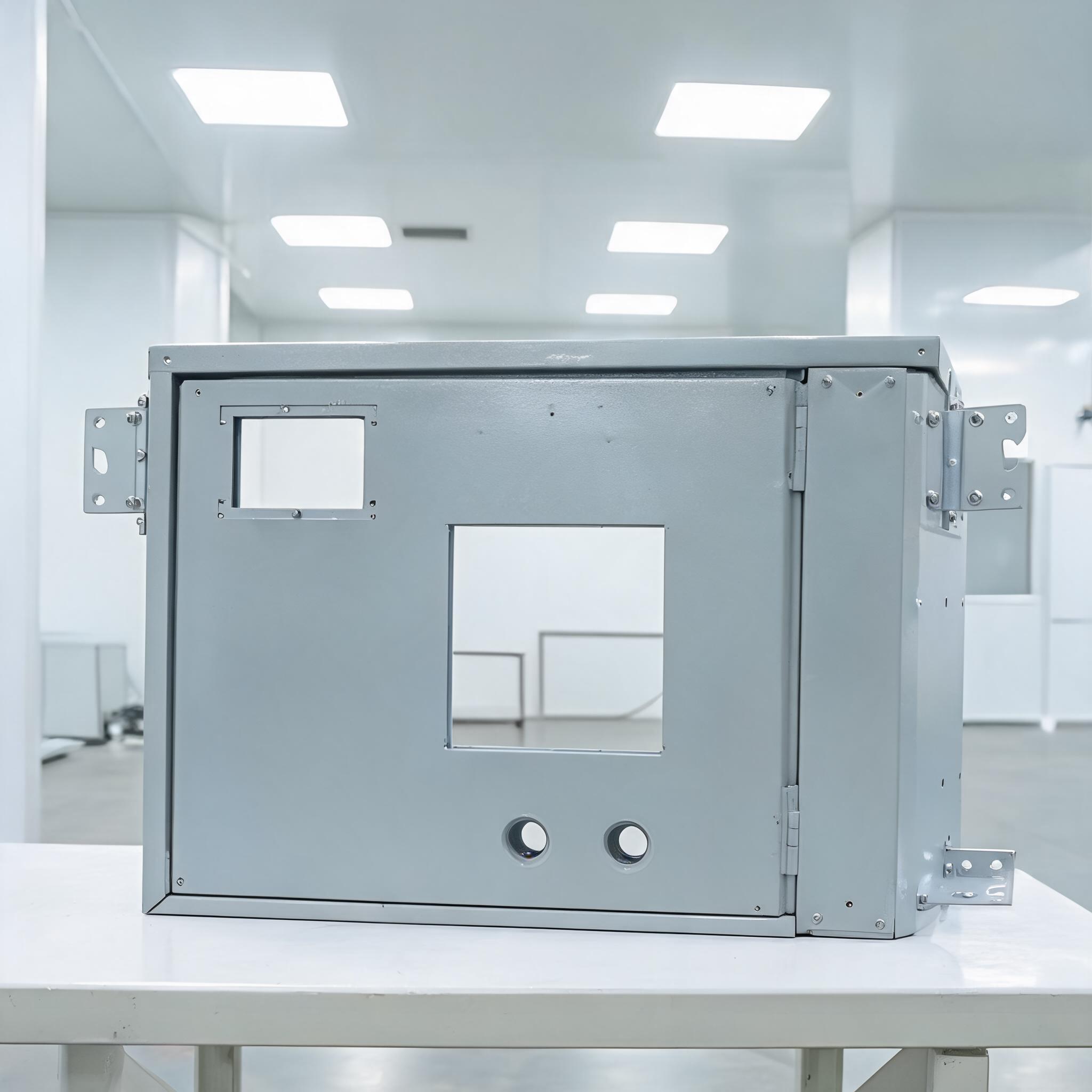
A routing guide for buyers placing mixed-material orders. Learn when powder coating fits steel enclosures, when Type II or III anodizing fits aluminum, and how to plan coating sequence around hardware and masking on assemblies that use both.
Mixed-material orders stall at one question: which coating route applies to which part, and in what order. The answer usually follows the substrate. Steel gets powder coating, aluminum gets anodizing, and assemblies that combine both need a sequence decided before the first part is cleaned.
- Powder coating is applied electrostatically and cured thermally; it builds a film on the surface of steel and other conductive parts.
- Anodizing is an electrochemical conversion of the aluminum surface itself, offered as Type II or Type III depending on the required film.
- On mixed assemblies, decide whether hardware is coated, masked, or installed after coating, and set the order on the drawing.
- Deburring before either process determines whether the finish reads as clean or as a coating over tool marks.
Powder coating: best fit for steel enclosures
Powder coating applies a dry polymer powder to the part and holds it in place with an electrostatic charge, then cures it in an oven into a continuous film. That film sits on top of the steel, so its thickness is measurable and can be specified.
For sheet metal enclosures, cabinets, and brackets, the relevant details are practical rather than theoretical:
- Film thickness per drawing. Ranges are typically stated on the drawing or in the finish note. If no value is given, ask the vendor to confirm before production rather than assume a default.
- Color reference. RAL numbers are the common shorthand; a customer sample or physical color chip is the alternative when a project is not tied to a standard RAL range.
- Masking. Threads, press-fit bores, grounding points, and mating surfaces are masked so the film does not alter fit or electrical contact. List them on the drawing.
- Cure and part thickness. Heavy-gauge parts take longer to reach cure temperature than thin panels, so a mixed batch of gauges is a scheduling input, not just a coating input.
Powder coating is a surface-additive finish. If a bore has a tolerance that the film would close up, that is a masking decision, not a coating decision, and it belongs on the drawing before the part reaches the line.
Anodizing: best fit for aluminum parts
Anodizing works differently. Instead of adding material, it converts the aluminum surface into an oxide layer as part of the metal. That distinction matters for buyers because the finish cannot chip off the way an applied film can, and the dimensional effect is small and predictable relative to the part.
Two common types appear in production drawings:
- Type II (sulfuric anodizing). The general-purpose route for aluminum housings, panels, and machined components where a controlled, uniform finish is the requirement.
- Type III (hard anodizing). Produces a thicker, harder oxide layer for wear-facing surfaces. Because it is thicker, the growth on the part has to be reconciled with tolerances and thread fits.
Anodizing is aluminum-specific. It cannot replace powder coating on a steel part, and a steel fastener in an anodized assembly will not receive the same finish. Color is also handled differently: dyeing and sealing steps follow the anodizing bath, so the color reference should be agreed in advance, ideally as a RAL number or a customer-approved sample.
Mixed assemblies: coating sequence and masking
This is where mixed-material orders go wrong. A single enclosure may contain a steel frame, an aluminum faceplate, and stainless hardware. Each item has a correct finish, but the assembly has a sequence, and that sequence has to be set before processing.
The practical options are:
- Coat before assembly. Components are finished individually and joined afterward. This is the cleanest route when hardware positions, threads, or electrical contact points must remain bare, because each part can be masked on its own.
- Assemble, then coat. Only workable when the whole assembly can tolerate the same process. It is not viable when aluminum and steel parts are combined, since no single process covers both.
- Coat, then install hardware. The frame or panel is finished with hardware holes masked, and fasteners are added after cure. This is common for enclosures where a scratched or coated thread would be unacceptable.
Two inputs decide which route applies: the finish call-out on each part, and the torque or thread requirement of each fastener. Write both on the drawing. If a thread must be free of coating, say so; masking a thread is a deliberate operation, not a default. If a fastener is installed after coating, confirm that the fastener itself carries the required finish, because it will not inherit the panel's coating.
For assemblies, a short checklist keeps the sequence unambiguous:
- Finish call-out per component: powder over steel, anodize over aluminum.
- Rotation notes for masking: threads, bores, grounding pads, weld areas.
- Sequence: coat before or after hardware installation.
- Color reference: RAL number or customer sample, with a note on which parts it covers.
- Film or layer thickness per part, when the drawing specifies it.
Comparing the two routes
The two processes are not interchangeable substitutes. They apply to different substrates and behave differently under wear, abrasion, and assembly handling.
| Factor | Powder coating | Anodizing |
|---|---|---|
| Substrate | Steel and other conductive parts | Aluminum only |
| How it forms | Electrostatic application plus thermal cure; film builds on the surface | Electrochemical conversion of the aluminum surface |
| Common types | Single-process finish, specified by color and film thickness | Type II, Type III depending on required layer |
| Color matching | RAL or customer sample | RAL or customer sample, with dye and seal steps after anodizing |
| Thickness control | Per drawing; affects bores and threads | Layer growth is small relative to part; still reconciled with tolerances and threads |
| Masking focus | Threads, bores, grounding points, mating surfaces | Contact and thread areas that must remain conductive or bare |
| Pre-treatment | Deburring and cleaning before application | Deburring and cleaning before the bath |
Neither route is inherently better. A drawer slide made of steel will not be anodized; an aluminum housing will not be powder coated just because the rest of the order is. Route selection follows the material first, then the function of the surface.
One line, two processes
A fabrication line that handles both processes together removes the hand-off that causes finish mismatches on mixed orders. The work moves through one sequence:
- Deburring and cleaning. Both routes need a clean, burr-free surface. Sharp edges and machining marks show through either finish, so this step is shared.
- Routing by material. Steel parts are assigned to powder coating; aluminum parts are assigned to anodizing. The assignment is made from the part drawing, not from the order as a whole.
- Masking per part. Each part is masked according to its own drawing call-out, including hardware positions and threads.
- Processing. Powder-coated parts move through electrostatic application and thermal cure; anodized parts move through the anodizing bath and any required dye and seal steps.
- Reassembly. Hardware is installed either before coating only where the process allows it, or after finishing where threads and fits must stay clean.
Buyers with mixed orders benefit from this arrangement because the sequence plan is made once, at the line, instead of being resolved part-by-part across vendors. The services involved map to two production capabilities: Custom Powder Coating Services for the steel components, and Custom Aluminum Anodizing Services for the aluminum components.
Quality systems matter here as well. Where a project falls under automotive supply requirements, the finishing operation is expected to sit inside an IATF 16949:2016 quality management framework, with process controls and traceability aligned to the part rather than to the batch alone. Buyers working to that standard should confirm the applicable certification scope with the supplier and match it to the specific parts on the order.
FAQ
Can one part receive both powder coating and anodizing?
Not in the usual case. Powder coating applies to steel and other conductive substrates, while anodizing converts an aluminum surface. A single part would need to be split by material, or the two processes applied to different components of the same assembly.
How do I know whether my aluminum part should be Type II or Type III anodized?
Type II is the general-purpose finish for appearance and uniform coverage; Type III produces a thicker, harder layer for wear-facing surfaces. The choice depends on whether the part's function is primarily cosmetic or wear-related, and it should be confirmed against the drawing before production.
Should hardware be installed before or after coating?
It depends on the thread and fit requirements. Where a thread must remain free of coating, install hardware after finishing or mask the thread during processing. Where the assembly can tolerate the same finish, coating before installation is possible. State the requirement on the drawing.
What color references work for both finishes?
RAL numbers are the common reference for both. A customer-supplied physical sample is the alternative when a project does not follow a standard RAL range. Anodized color is produced through dye and seal steps after the anodizing bath, so the reference should be agreed before the parts are processed.
Sending a mixed-material order? Include the material of each part, the required finish per part, the color reference, the masking points, and whether hardware is installed before or after coating. Those five items let the line route and sequence the whole order in one pass.
For steel components, review custom powder coating services; for aluminum components, review custom aluminum anodizing services.